
NEWS
Data is empty
Adjustable Armrest Solutions: How to Choose the Right Office Chair Armrest for OEM Projects
The armrest is more than a supporting component, it directly influences perceived comfort, chair functionality, product positioning, and the overall user experience. As ergonomic seating continues to emphasize adjustability, an adjustable chair armrest has become an important component for office chair development and product upgrades.
FSGROWING provides office chair components for manufacturers and furniture buyers, including adjustable armrest solutions designed for office seating applications.
1. Why Adjustable Armrests Matter in Office Chair Design
Office users do not have identical body proportions, working habits, or desk configurations. A fixed armrest provides a predetermined support position, while an adjustable design allows the user to modify the arm position according to individual requirements.
Adjustability can be particularly valuable in chairs designed for long working periods. A suitable armrest position can provide a stable surface for the forearm while helping users maintain a more natural relationship between the upper arm, elbow, wrist, and desktop.
From a product-development perspective, adjustability also gives manufacturers greater flexibility. One armrest platform can potentially serve different chair models or user groups when its structure and mounting interface are appropriately designed.
Modern ergonomic seating demonstrates this trend clearly: manufacturers increasingly distinguish chairs through height, depth, width, and angle adjustment rather than relying solely on cushioning or appearance. Industry component suppliers likewise offer 2D, 3D, 4D, and other adjustable armrest configurations for OEM applications.

2. What Makes a Good Adjustable Chair Armrest?
An effective adjustable chair armrest should balance ergonomics, mechanical performance, material selection, and production requirements.
Adjustment Mechanism
The mechanism determines how the armrest moves and how securely it remains in position. Depending on the chair design, adjustment may include vertical movement, forward and backward movement, lateral movement, or angular rotation.
The adjustment mechanism should provide:
Smooth and predictable movement
Reliable positioning after adjustment
Appropriate resistance during operation
Minimal unwanted movement during use
Consistent performance across production batches
This is particularly important for OEM manufacturers. An armrest that feels stable during initial assembly but gradually develops looseness can negatively affect the perceived quality of the entire chair. Position-control solutions are therefore an important consideration in adjustable armrest engineering.
Structural Strength
The armrest assembly needs to withstand repeated loading and everyday handling. Users may place their forearms on the pad, move their arms while working, or occasionally apply greater loads when entering or leaving the chair.
Consequently, buyers should evaluate the complete assembly rather than focusing only on the visible pad. The arm support, adjustment mechanism, mounting interface, fasteners, and connection points all contribute to long-term performance.
Arm Pad Material
The pad is the part directly contacted by the user. PU pads are commonly selected for ergonomic seating because they can provide a softer touch compared with hard plastic surfaces.
For manufacturers, the pad should also be evaluated for surface feel, shape retention, dimensional consistency, cleaning requirements, and compatibility with the chair's visual design.
3. Key Specifications to Evaluate Before Purchasing
A professional sourcing process should begin with a technical specification rather than a product photograph.
1. Mounting Interface
Confirm the mounting hole pattern, screw configuration, connection geometry, and available installation space. Compatibility problems at this stage can make an otherwise suitable armrest unusable.
2. Adjustment Range
Do not evaluate adjustability only by counting the number of directions. The actual movement range is equally important.
For example, two armrests may both be described as height-adjustable but provide different usable ranges. Buyers should determine whether the range is appropriate for the intended chair structure, seat height, desk height, and target user group.
3. Pad Dimensions and Shape
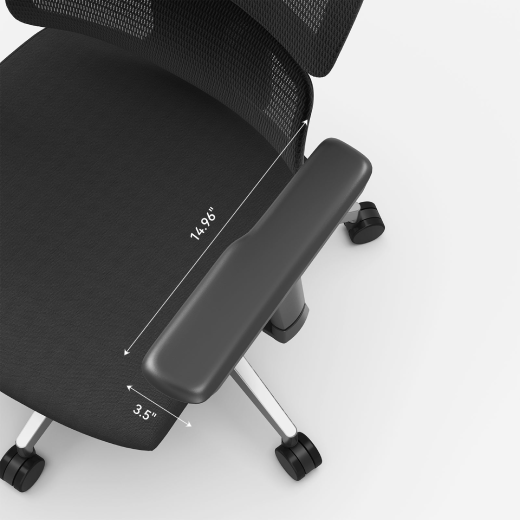
Pad width, length, thickness, curvature, and edge treatment influence both comfort and product appearance. The pad should be considered together with the chair's seat, backrest, and overall ergonomic geometry.
4. Material and Surface Requirements
Specify the material of the support structure and pad, surface finish, hardness or softness requirements, and color expectations where applicable.
5. Load and Durability Requirements
For commercial seating, armrests are repeatedly used over an extended service life. Buyers should discuss the intended application and required durability testing with the supplier before mass production.
A professional supplier should be able to explain how the product is manufactured and what quality-control procedures are applied rather than simply providing a catalogue photograph.
4. Adjustable Armrest Solutions for OEM and Replacement Applications
Adjustable armrests are not limited to new chair development. They can also be used in chair refurbishment and component replacement projects.
OEM Chair Development
For an OEM project, the armrest should be developed as part of the complete chair system. The supplier needs to understand the chair's seat structure, backrest, mounting points, target market, and desired adjustment functions.
This approach can reduce the risk of selecting an armrest that performs well independently but does not integrate properly with the final chair.
Chair Upgrades
A manufacturer may also upgrade an existing chair platform by replacing a fixed armrest with an adjustable solution. This can add functionality without completely redesigning the chair.
The key is to verify mechanical compatibility before production. An adjustable armrest is not automatically a universal replacement component.
Armrest Replacement
For distributors and furniture-service companies, armrest replacement can extend the useful life of an existing chair. Common replacement requirements include damaged pads, worn mechanisms, broken support structures, or outdated armrest designs.
Recent user discussions about replacement armrests also demonstrate a recurring sourcing problem: even when the chair remains functional, finding a compatible replacement can be difficult because mounting configurations and component designs vary between chair models.
For this reason, buyers should provide the chair model, existing armrest dimensions, mounting-hole information, photographs, and required functions when requesting a replacement solution.
5. Why Work with an Experienced Office Chair Component Supplier?
A reliable supplier should be able to communicate clearly about:
Product construction and materials
Adjustment mechanism
Mounting compatibility
Production capability
Quality-control procedures
Sample development
OEM/ODM requirements
Packaging and delivery
Technical documentation
This information helps purchasing teams evaluate total supply risk instead of comparing unit prices alone.
FSGROWING focuses on office chair components and provides an adjustable office chair armrest with a PU pad for office chair applications. For buyers developing or upgrading ergonomic seating, the product can be considered as a component solution rather than simply a replacement accessory.
For OEM projects, the most useful approach is to discuss the chair's technical requirements with the supplier before confirming the final configuration. This allows the armrest structure, mounting interface, adjustment function, and pad design to be evaluated together.
6. A Practical Sourcing Checklist for B2B Buyers
Before placing a bulk order, buyers can use the following checklist:
Application: Is the armrest intended for task chairs, executive chairs, conference chairs, or another seating application?
Adjustment: Which adjustment directions are actually required?
Compatibility: Does the mounting structure match the chair frame?
Materials: Are the arm support and PU pad materials suitable for the intended market?
Durability: What testing or quality requirements apply to the finished chair?
Consistency: Can the supplier maintain stable dimensions and assembly quality during mass production?
Customization: Can the supplier support required colors, pad shapes, mounting configurations, or other OEM specifications?
Quality control: Are incoming materials, production processes, and finished components inspected?
This checklist helps transform armrest purchasing from a simple accessory order into a structured component-sourcing process.
FAQ About Adjustable Office Chair Armrests
What is an adjustable chair armrest?
An adjustable chair armrest is an arm support that allows users to change its position according to their body dimensions, working posture, or desk configuration. Depending on the design, adjustment may include height, depth, width, or angle.
What is the difference between an office chair armrest and an adjustable armrest?
An office chair armrest is a general term for the arm-support component of a chair. An adjustable armrest specifically incorporates one or more mechanisms that allow its position to be changed.
Can an adjustable armrest be used as an armrest replacement?
Yes, but compatibility must be verified first. Buyers should compare the mounting pattern, dimensions, connection structure, and adjustment mechanism with the existing chair before ordering an armrest replacement.
Is a PU pad suitable for an office chair armrest?
PU is commonly used for arm pads because it provides a relatively soft contact surface and can complement ergonomic office seating designs. The appropriate material and specification depend on the chair's application and product requirements.
How many adjustment directions does an adjustable chair armrest need?
There is no universal requirement. The appropriate configuration depends on the chair's target users, price positioning, ergonomic objectives, and mechanical design. More adjustment directions are not automatically better if they add unnecessary complexity or cost.
What information should I provide when requesting adjustable armrests in bulk?
Provide the chair model or drawings, mounting-hole dimensions, photographs, required adjustment functions, pad dimensions, material requirements, estimated order quantity, target market, and any testing or customization requirements. This gives the supplier enough information to recommend a suitable configuration.
Contact FSGROWING to discuss your adjustable office chair armrest requirements, request product details, and evaluate an appropriate solution for your OEM or replacement project.
Ergonomic Chair Parts List: Guide to Ergonomic Office Chair Components and Seat Design
Reclining Mechanism Explained
Latest Blog