
NEWS
Data is empty
What Makes an Office Chair Armrest Truly Ergonomic?
Armrests are often treated as secondary components in office chair design, yet they directly influence shoulder relaxation, forearm support, desk positioning, and long term sitting comfort. A poorly designed armrest can force the shoulders upward, leave the forearms unsupported, or restrict how closely a chair can approach a desk.
1. What Makes an Ergonomic Armrest Different From a Standard Office Chair Armrest?
Why is armrest height so important for ergonomic office chair design?
Height is the foundation of armrest positioning. When the armrest is too high, users may elevate their shoulders. When it is too low, the forearms receive insufficient support and users may compensate by leaning forward or placing more weight on the desk.
An effective adjustment range should therefore allow the user's shoulders to remain relaxed while the forearms are comfortably supported. However, there is no universal height that fits everyone. Seat height, desk height, torso length, arm length, and working posture all affect the appropriate position.
For this reason, adjustable height is generally more useful than simply adding mechanical features without considering actual user requirements.
How do 2D, 3D, and 4D armrests improve user fit?
The terms 2D, 3D, and 4D generally describe the number of adjustment directions available.
A 2D design may provide height and another movement such as forward/backward adjustment. A 3D design can add lateral movement, while a 4D armrest may provide additional pad movement or rotation.
More adjustment does not automatically mean better ergonomics. Each movement should solve a specific fitting problem. For example, forward/backward adjustment can help users position the pad beneath the forearm when switching between keyboard and mouse use. Lateral adjustment can accommodate different shoulder widths.
The important specification is therefore not simply the number of dimensions, but the usable adjustment range, stability, and ease of adjustment.
Why do armrest width and depth matter?
Armrest width affects how naturally the arms fall beside the torso. Excessive spacing can force the elbows outward, while insufficient spacing may restrict movement.
Depth is particularly important for computer users. The optimal arm position for typing is not necessarily the same as the position used for reading, writing, or reclining. Adjustable pads allow users to change support according to the task instead of adapting their body to a fixed component.
2. How Should Chair Armrest Pads Be Designed for Long Term Comfort?
What role do chair armrest pads play in ergonomic performance?
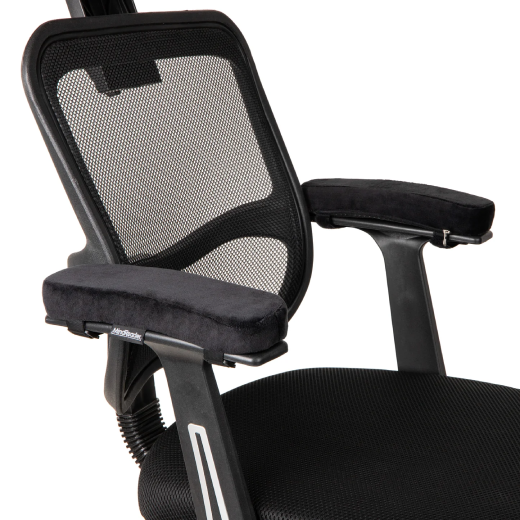
The pad is the primary contact surface between the user's arm and the chair. Its material, hardness, thickness, shape, and edge design determine how pressure is distributed.
A narrow or excessively hard pad can concentrate pressure around the elbow and forearm. A properly designed surface distributes contact more evenly while maintaining enough firmness for stable support.
Therefore, chair armrest pads should be considered a functional ergonomic component rather than merely a decorative part.
Are softer chair armrest pads always more comfortable?
Not necessarily.
Very soft padding may initially feel comfortable but can compress during prolonged use and provide inconsistent support. Excessive compression can also accelerate material deformation.
For commercial office chairs, controlled cushioning is usually more practical. PU and other resilient materials can provide a balance between cushioning, durability, cleanability, and manufacturing consistency.
The correct material depends on the chair's positioning, expected service life, usage intensity, and target market.
What pad shape works best for ergonomic armrest design?
A useful pad should provide sufficient support for the forearm without becoming so large that it interferes with desk clearance.
Rounded edges are also important because sharp edges can create pressure points when the user changes position.
The chair armrest pads and mechanism must be designed together. A comfortable pad cannot compensate for an armrest that is positioned too far outward or cannot adjust to the user's working posture.
How does an armrest affect desk compatibility?
Desk clearance is one of the most overlooked issues in armrest design.
If armrests cannot lower sufficiently, users may be unable to move the chair close enough to the desk. This can increase reaching distance and encourage forward leaning.
Consequently, the vertical range of an armrest should be evaluated alongside typical desk heights and the chair's seat-height range.
3. When Is Office Chair Armrest Replacement Better Than Replacing the Chair?
Can worn chair armrest pads be replaced separately?
In many cases, yes.
An office chair armrest normally consists of several components, including the mounting structure, support bracket, adjustment mechanism, and upper pad. If the structure remains stable but the pad becomes cracked, worn, or uncomfortable, replacing the pad may be sufficient.
This makes office chair armrest replacement valuable for distributors, facility managers, and aftermarket service providers.
Replacing individual components can extend chair service life and reduce unnecessary disposal of otherwise functional furniture.
What should buyers check before ordering replacement chair armrest pads?
Appearance alone is not enough to determine compatibility.
Buyers should verify:
Mounting-hole spacing
Pad length and width
Screw or insert specifications
Underside mounting structure
Existing armrest mechanism
Adjustment configuration
Single-piece or pair packaging requirements
For OEM buyers, technical drawings and physical samples are especially useful because visually similar armrests may use different mounting interfaces.
When should the complete armrest assembly be replaced?
If the pad is damaged but the mechanism works correctly, a replacement pad may solve the problem.
However, if the support bracket is cracked, the mounting structure is damaged, or the adjustment mechanism cannot maintain its position, replacing only the pad will not address the root cause.
This distinction is important for after-sales programs because different failures require different replacement strategies.
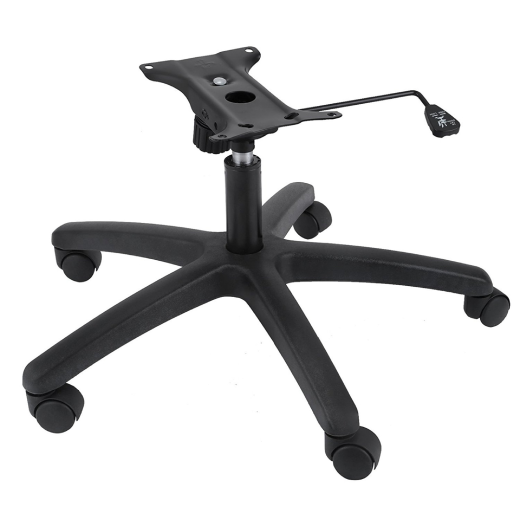
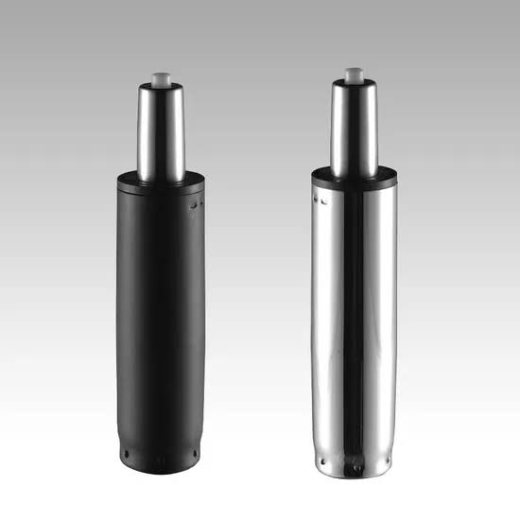
FSGROWING operates specialized workshops that work together to produce different office chair components, including casters, chair bases, gas lift cylinders, mechanism plates, seat shells, backrests, headrests, armrests, and more. This component-oriented production structure reflects an important principle in chair manufacturing: armrest performance needs to be considered alongside the chair's other structural components.
4. What Should B2B Buyers Evaluate When Choosing an Ergonomic Armrest?
Should manufacturers prioritize adjustment functions or durability?
The answer depends on the intended chair.
A basic task chair may only require reliable height adjustment. A premium ergonomic chair may benefit from additional lateral, depth, and pivot adjustments because users frequently change working positions.
Regardless of configuration, the mechanism must remain stable after repeated adjustment. A sophisticated armrest that develops excessive play or gradually loses its position provides little practical ergonomic value.
What quality problems should manufacturers test?
Mass production requires more than checking whether an armrest works on a prototype.
Important quality control areas include:
Adjustment-force consistency
Locking performance
Structural strength
Mounting-hole accuracy
Pad attachment
Surface durability
Repeated adjustment performance
Dimensional tolerances
Unwanted movement and noise
For OEM procurement, sample testing should therefore cover both appearance and repeated mechanical performance.
What is the biggest mistake in ergonomic armrest design?
The biggest mistake is treating ergonomics as a checklist of features.
A chair does not become ergonomic simply because it has a "4D armrest." Adjustment range, body fit, mechanical stability, pad geometry, desk compatibility, and durability determine whether those features actually provide value.
The better purchasing question is:
What specific user problem does each adjustment solve, and can the mechanism continue solving it throughout the expected service life?
FAQ: Common B2B Questions About Ergonomic Armrest Design
Are 4D armrests always better than 2D armrests?
No. More adjustment provides greater flexibility, but only when the movement range is useful and the mechanism remains stable. A well-designed 2D armrest can outperform a poorly engineered 4D design.
Are chair armrest pads universal?
No. Mounting-hole patterns, dimensions, screws, and underside structures can vary between chair models. Compatibility should always be confirmed before purchasing replacement parts.
When should an office chair armrest be replaced completely?
A complete replacement is appropriate when the support structure, bracket, mounting interface, or adjustment mechanism is damaged. If only the contact surface is worn, replacing the chair armrest pads may be sufficient.
What should OEM buyers request from an armrest supplier?
Buyers should evaluate technical drawings, adjustment ranges, materials, mounting specifications, durability requirements, samples, tolerances, and production consistency rather than relying only on product photographs.
Can ergonomic armrests solve poor workstation posture?
They can provide useful forearm support and help maintain a more relaxed upper-body position, but armrests cannot compensate for an incorrectly positioned desk, monitor, keyboard, or seat. Ergonomic performance depends on the complete workstation.
If you are evaluating armrest components for an office chair project, OEM development, or replacement-parts program, discussing the required dimensions, adjustment configuration, mounting structure, and application conditions with a component manufacturer can help establish a more practical specification before production.

Latest Blog