
NEWS
Data is empty
Plywood Chair: Types, Materials, Structure and Commercial Applications
Plywood chairs are widely used in residential, office, hospitality, and institutional furniture markets. Their popularity comes from a combination of structural stability, relatively low weight, design flexibility, and efficient material utilization. From molded dining chairs to upholstered office seating, plywood provides manufacturers with opportunities to balance appearance, durability, and production costs.
Choosing the right plywood chair requires more than comparing product designs. Veneer quality, panel thickness, adhesive performance, structural engineering, and hardware compatibility all influence the finished product's service life.
1. What Is a Plywood Chair and What Types Are Available?
1.1 How Does Plywood Differ from Solid Wood in Chair Manufacturing?
A plywood chair is manufactured using multiple thin wood veneers bonded together, usually with adjacent grain directions arranged at approximately 90-degree angles. This cross-laminated structure helps distribute mechanical loads and reduces dimensional movement compared with many solid wood constructions.
Plywood offers several advantages in furniture production:
- Dimensional stability: Cross-laminated veneers help reduce warping, splitting, and uneven shrinkage.
- Strength-to-weight ratio: It provides useful structural performance without excessive weight.
- Material efficiency: Standardized panels allow efficient cutting and nesting.
- Design flexibility: Veneers can be molded into curved seats and backrests.
- Production consistency: Standard panel specifications simplify mass manufacturing.
However, plywood is not automatically stronger than solid wood in every application. Its performance depends on veneer quality, bonding strength, panel construction, and loading direction.
1.2 What Are the Main Types of Plywood Chairs?
Different plywood chair designs serve different commercial and functional requirements.
| Chair type | Main construction | Typical applications | Key considerations |
| Molded plywood chair | Heat-formed curved veneers | Dining rooms and lounges | Mold accuracy and bonding |
| Flat-panel plywood chair | Cut and assembled panels | Cafés and schools | Edge strength and joints |
| Upholstered plywood chair | Plywood with foam and fabric | Offices and hotels | Fastener retention |
| Stackable plywood chair | Lightweight panel structure | Conference rooms | Weight and impact resistance |
| Lounge plywood chair | Curved shell and supporting frame | Hospitality furniture | Ergonomics and deformation |
Molded designs prioritize ergonomic curvature and appearance, while flat-panel models simplify cutting and assembly. Upholstered plywood chairs require additional attention to the interaction between the wooden substrate, foam, fabric, and fastening system.
2. What Materials and Structural Components Determine Plywood Chair Quality?
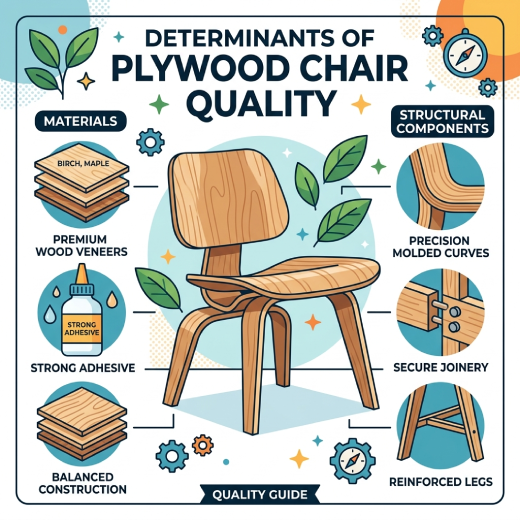
2.1 Which Plywood Materials Are Best for Different Chair Applications?
The selection of chair plywood should begin with its intended application rather than price alone. Different wood species provide different balances of density, stiffness, weight, and appearance.
| Material | Main characteristics | Potential applications |
| Birch plywood | Dense and relatively uniform | Structural seating and exposed edges |
| Poplar plywood | Lightweight and easy to process | Cost-sensitive furniture |
| Eucalyptus plywood | Relatively dense and strong | Structural panel applications |
| Hardwood plywood | Versatile veneer options | Decorative and commercial furniture |
| Flexible plywood | Designed for bending | Curved furniture components |
The number of veneer layers also matters, but more layers do not automatically guarantee better quality. Balanced veneer arrangements, appropriate thickness, and reliable adhesive bonding are more important.
2.2 How Do Thickness, Adhesives, and Veneer Direction Affect Strength?
Panel thickness influences bending stiffness, but overall durability depends on several interacting factors. Cross-laminated veneers help distribute loads, while poor adhesive bonding can cause delamination under repeated stress or moisture fluctuations.
Commercial buyers should examine:
- Panel thickness and manufacturing tolerances.
- Veneer species, grade, and core composition.
- Internal voids and bonding quality.
- Moisture content and dimensional consistency.
- Surface finishing and edge protection.
- Formaldehyde emission documentation where required.
For products entering the US market, buyers should verify applicable TSCA Title VI requirements for regulated composite wood products. Material compliance should be supported by appropriate documentation rather than general environmental claims.
2.3 Why Are Structural Connections as Important as the Plywood Panel?
A chair's durability depends on how loads transfer between the seat, backrest, frame, and connectors.
The seat supports body weight and transfers forces toward the legs or supporting structure. The backrest experiences repeated leaning forces, creating bending moments around its attachment points. Armrests introduce additional localized loads.
Common failure points include drilled holes, panel edges, and hardware connections.
A reliable design should consider:
1. Load distribution: Avoid concentrating excessive stress around individual screws.
2. Edge reinforcement: Use suitable inserts or brackets where necessary.
3. Joint durability: Evaluate screw withdrawal resistance and repeated assembly performance.
4. Ergonomics: Match seat depth, backrest angle, and curvature to intended users.
5. Surface protection: Reduce moisture penetration and everyday wear.
3. How Are Plywood Chairs Manufactured and Used in Commercial Markets?
3.1 What Are the Key Manufacturing Processes?
The manufacturing quality of plywood seating depends on controlling each production stage.
Step 1: Veneer preparation and grading
Veneers are selected according to species, thickness, moisture content, and surface condition. Defective materials can affect bonding and finished appearance.
Step 2: Layer arrangement and adhesive application
Veneers are arranged in balanced configurations, and adhesives are applied between layers. Consistent distribution helps prevent weak bonding areas.
Step 3: Pressing and molding
Flat panels are pressed under controlled temperature and pressure. Specialized molds produce curved components for ergonomic seating designs.
Step 4: CNC cutting and machining
Panels are cut into seats and backrests. Drilling, edge profiling, and dimensional inspection ensure compatibility with the assembly structure.
Step 5: Surface finishing and assembly
Sanding, painting, laminating, and veneer treatments improve appearance and protect against everyday wear. Components are then assembled and inspected for dimensional accuracy and joint stability.
Moisture control is particularly important. Panels that are inadequately conditioned may change dimensions after machining, causing alignment problems during assembly or transportation.
3.2 Where Are Plywood Chairs Commonly Used?
Different commercial markets have different performance requirements.
| Commercial market | Typical requirements | Purchasing priorities |
| Hotels and restaurants | Attractive appearance and frequent-use durability | Cleaning resistance |
| Offices and meeting rooms | Comfortable and stable seating | Ergonomics and joint strength |
| Schools and universities | Impact resistance and easy maintenance | Safety and repairability |
| Healthcare facilities | Easy-to-clean surfaces | Hygiene and compliance |
| Retail projects | Consistent appearance across multiple units | Bulk production capacity |
3.3 How Do Other Furniture Components Affect Plywood Chair Performance?
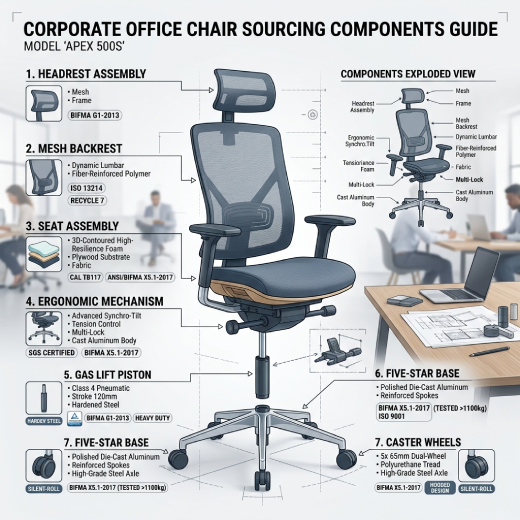
A finished chair is a coordinated assembly rather than an isolated wooden product. Depending on its design, it may incorporate metal frames, plastic shells, casters, gas lift cylinders, mechanisms, armrests, and upholstery.
For example, an upholstered plywood seat requires accurately positioned mounting points. Poor coordination between the panel and its supporting hardware can cause screw loosening or localized damage under repeated loading.
4. How Should B2B Buyers Evaluate Plywood Chair Suppliers?
4.1 What Should Importers and Wholesalers Check Before Bulk Purchasing?
- Material specifications: Confirm veneer species, panel thickness, and core construction.
- Sample evaluation: Inspect surface quality, edges, dimensions, and mounting points.
- Structural testing: Request relevant load and durability reports.
- Environmental compliance: Verify applicable emission requirements and documentation.
- Production consistency: Confirm the supplier can maintain specifications across batches.
- Packaging and logistics: Evaluate moisture protection and transportation damage prevention.
4.2 Industry Pain Points: Frequently Asked Questions
Q1: Why does a plywood chair crack around screw holes?
Common causes include insufficient edge distance, incorrect pilot-hole sizing, weak core construction, and excessive tightening torque. Repeated loading gradually weakens the connection. Manufacturers should optimize fastener positions and consider suitable inserts or reinforcement.
Q2: Does thicker chair plywood always mean better durability?
No. Thickness improves bending stiffness under comparable conditions, but veneer quality, bonding strength, support conditions, and joint engineering are equally important. Buyers should evaluate the complete structure rather than thickness alone.
Q3: Why do plywood seats become warped after delivery?
Moisture changes, inadequate panel conditioning, and insufficient packaging protection can contribute to deformation. Suppliers should control moisture content and protect finished components during storage and transportation.
Q4: How can importers reduce delamination risks in bulk orders?
Request information about adhesive systems, pressing conditions, and bonding quality. Sample inspections should include exposed edges and drilled areas. Appropriate bonding or durability test results can provide additional assurance.
Q5: How can manufacturers balance cost and quality when selecting plywood?
The lowest material price does not necessarily produce the lowest overall cost. Buyers should compare material utilization, machining losses, defect rates, assembly efficiency, expected service life, and replacement expenses.
If you are developing a new office seating range or evaluating furniture component configurations, discussing material specifications, connection designs, and component compatibility with an experienced furniture manufacturer FSGROWING is a practical starting point for improving product reliability and controlling long-term procurement costs.
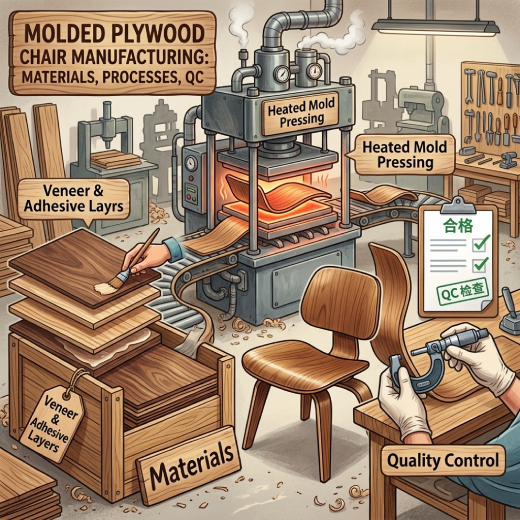
Molded Plywood Chair Manufacturing: Materials, Molding Processes and Quality Control
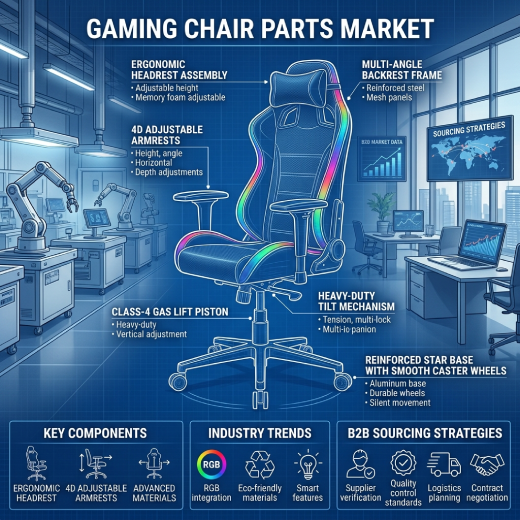
Gaming Chair Parts Market: Key Components, Industry Trends, and B2B Sourcing Strategies
Related blog
Latest Blog