
NEWS
Data is empty
Industrial Seating Solutions: How to Choose Durable, Ergonomic and Cost Effective Chair Components for Industrial Workspaces
Industrial seating solutions play an important role in manufacturing facilities, assembly lines, laboratories, workshops, and technical workstations. Unlike conventional office chairs, industrial seating must accommodate different working postures, operating conditions, load requirements, and maintenance demands. A chair that performs well in an office may not provide sufficient durability, stability, or ergonomic support in a demanding production environment.
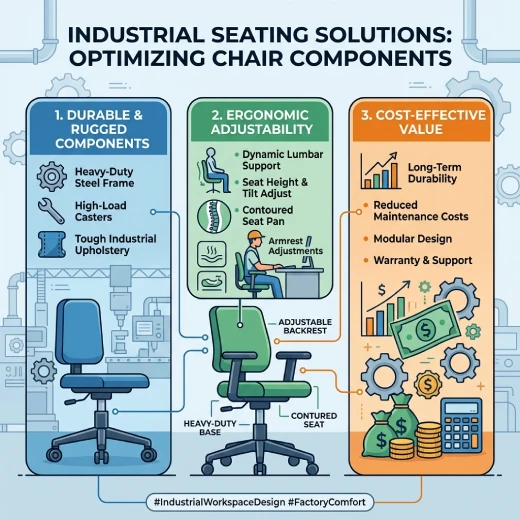
1. What Are Industrial Seating Solutions and Which Work Environments Require Them?
Industrial seating solutions refer to chairs, stools, and adjustable seating systems designed for workplaces where employees perform repetitive, precision-based, or prolonged seated tasks. Their primary purpose is to provide appropriate support while maintaining stability, mobility, and operational efficiency.
What Is the Difference Between Industrial Seating and Conventional Office Chairs?
The main difference lies in the operating environment. Office chairs generally prioritize appearance, comfort, and general-purpose adjustability. Industrial seating must also address environmental exposure, cleaning requirements, equipment compatibility, and structural durability.
Common industrial seating applications include:
- Manufacturing workshops: Adjustable chairs and stools for assembly, inspection, and repetitive production tasks.
- Laboratories: Non-porous seating surfaces that support routine cleaning and hygiene requirements.
- Electronics facilities: ESD-compatible seating designed to control electrostatic discharge.
- Technical workstations: Ergonomic seating that supports precision work and extended sitting periods.
- Warehouses and inspection areas: Stable, durable seating with suitable mobility and load capacity.
Accordingly, selecting industrial chair parts should begin with an assessment of the actual working environment rather than simply choosing a chair based on appearance or price.
What Technical Requirements Should Industrial Seating Meet?
Several factors determine whether a seating solution is appropriate for industrial applications.
| Evaluation Factor | Technical Consideration | Why It Matters |
| Structural stability | Base strength, connection integrity, load capacity | Reduces tipping and structural failure |
| Ergonomics | Seat height, backrest support, seat depth | Supports different body dimensions |
| Material performance | Wear, chemical and moisture resistance | Extends service life |
| Mobility | Caster material, diameter and braking | Improves movement and stability |
| Environmental compatibility | ESD properties and cleanability | Meets specialized workplace requirements |
| Maintenance | Replaceable cylinders, casters and mechanisms | Reduces replacement costs |
Industrial seating should also be evaluated against relevant testing requirements. ANSI/BIFMA standards, for example, provide performance and safety benchmarks for applicable seating categories. However, compliance claims should always be supported by appropriate product testing rather than assumed from component specifications alone.
2. Which Industrial Chair Parts Determine Performance, Durability and Ergonomic Comfort?
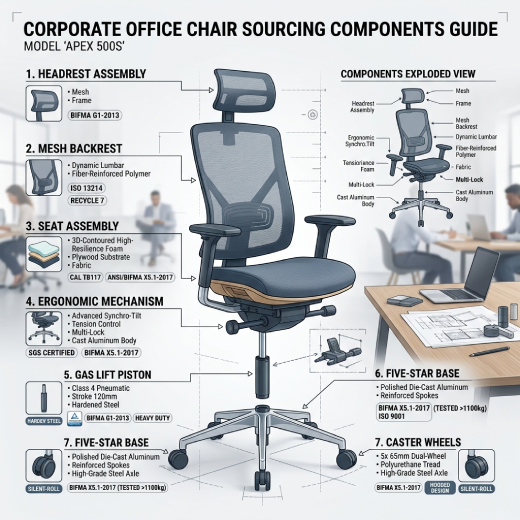
An industrial chair is a coordinated mechanical system. Its performance depends on how individual components work together, not simply on the quality of one major structural element.
How Do Different Chair Components Affect Industrial Seating Performance?
1. Chair Bases and Structural Support
The base workshop chair parts distributes the occupant's weight and provides stability during movement. Five-star bases are widely used in swivel seating because their support geometry helps distribute loads across multiple contact points.
Nylon bases factory chair components offer relatively low weight and cost, while aluminum bases provide a different balance of rigidity, appearance, and mechanical strength. Selection should consider load requirements, dimensions, and structural testing.
2. Gas Lift Cylinders and Height Adjustment
Gas lift cylinders workshop chair parts allow workers to adjust seat height according to workstation dimensions. Cylinder stroke, installation dimensions, load rating, and operating consistency must be considered together.
Incorrect cylinder specifications can result in insufficient adjustment range or compatibility problems between the seat and base.
3. Tilt Mechanisms and Backrest Support
Mechanism plates workshop chair parts control reclining, tilting, and locking functions. For industrial seating, mechanism durability and repeatable operation are important because adjustment components may experience frequent use.
4. Casters and Floor Compatibility
Caster workshop chair parts selection should match the floor surface and operating environment. Harder wheels may work better on carpet, while softer polyurethane wheels can help reduce noise and improve movement on certain hard floors.
5. Seat Shells, Backrests and Armrests
Seat shells workshop chair parts provide structural support, while backrests influence posture and upper-body comfort. Adjustable armrests can help accommodate different working heights and reduce unnecessary shoulder loading when correctly configured.
How Do Factory Chair Components Work Together?
The following table illustrates how factory chair components specifications influence the overall seating system.
| Component | Key Specification | Common Procurement Risk |
| Chair base | Material, diameter, load performance | Insufficient stability |
| Gas lift | Stroke, dimensions, load rating | Height incompatibility |
| Mechanism plate | Tilt angle, locking structure | Premature mechanical failure |
| Casters | Material, diameter, stem size | Poor floor compatibility |
| Seat shell | Dimensions, material thickness | Deformation or fitting issues |
| Backrest | Shape, adjustment range | Inadequate support |
| Armrests | Height, width, adjustment functions | Limited workstation compatibility |
3. How Are Industrial Seating Components Manufactured and Quality Controlled?
Industrial seating quality begins long before final assembly. Material selection, tooling accuracy, manufacturing consistency, and inspection procedures all influence the reliability of finished products.
What Manufacturing Processes Affect Industrial Chair Parts?
Different factory chair components require different production technologies.
- Plastic injection molding: Used for producing bases, armrests, seat shells, and other plastic components. Mold design, material flow, cooling conditions, and dimensional stability affect the finished product.
- Metal fabrication: Used for mechanisms, mounting plates, and structural hardware. Cutting, stamping, welding, and surface treatment must maintain dimensional accuracy and mechanical integrity.
- Gas lift production: Requires controlled assembly, sealing performance, and functional testing.
- Caster manufacturing: Involves wheel molding, bearing assembly, and dimensional inspection to ensure smooth rotation and suitable load performance.
What Quality Control Measures Should Buyers Evaluate?
A practical factory chair components quality management process should include several inspection stages:
1. Incoming material inspection: Verify material specifications, supplier consistency, and relevant certificates.
2. Production inspection: Monitor molding dimensions, metal processing accuracy, and assembly quality.
3. Component testing: Evaluate load performance, adjustment functions, rotation, and structural integrity.
4. Compatibility testing: Assemble different components to identify dimensional mismatches or mechanical interference.
5. Final inspection: Check appearance, functionality, packaging, and order specifications.
One frequently overlooked issue is that factory chair components testing and complete-chair testing are not interchangeable. Individual parts may pass their own inspections but still produce problems when assembled together.
4. How Can B2B Buyers Source Industrial Seating Components More Effectively?
What Should Buyers Compare When Evaluating Industrial Seating Suppliers?
A supplier evaluation should cover the following areas:
- Product range: Can the supplier provide multiple compatible components?
- Manufacturing capability: Does the supplier have relevant production equipment and specialized workshops?
- Customization: Can dimensions, materials, colors, and structural designs be adjusted?
- Quality assurance: Are inspection procedures and product test reports available?
- Production capacity: Can the supplier maintain consistent quality across repeat orders?
- Cost structure: Do material selection, tooling, transportation, and minimum order quantities affect the total cost?
What Are the Common Procurement Challenges and How Can Buyers Avoid Them?
| Industry Challenge | Underlying Cause | Recommended Approach |
| Inconsistent component dimensions | Different tooling or production tolerances | Establish approved drawings and inspection limits |
| High replacement frequency | Inappropriate material or insufficient testing | Evaluate application-specific durability |
| Assembly incompatibility | Different component interfaces | Conduct complete-chair compatibility tests |
| Unstable bulk quality | Inconsistent production processes | Introduce batch inspection and traceability |
| Excessive procurement costs | Over-specification or fragmented sourcing | Standardize components where practical |
FAQs About Industrial Seating Solutions
Q1: Are industrial seating components interchangeable between different chair models?
Not necessarily. Components may differ in mounting dimensions, stem sizes, connection structures, and load requirements. Buyers should verify compatibility through technical drawings and physical assembly tests rather than relying on visual similarities.
Q2: How can manufacturers reduce the long-term cost of industrial chair components?
Focus on total cost of ownership rather than purchase price alone. Standardized interfaces, replaceable components, consistent materials, and preventive quality testing can reduce maintenance expenses and product returns.
Q3: Which materials are most suitable for industrial chair bases?
Nylon, reinforced nylon, and aluminum are commonly used options. The appropriate choice depends on structural requirements, budget, environmental conditions, and product positioning.
Q4: Why do industrial chairs sometimes experience repeated gas lift or mechanism failures?
Common causes include incorrect component specifications, excessive loading, poor sealing, unsuitable installation dimensions, and inconsistent manufacturing quality.
Q5: Should B2B buyers prioritize integrated suppliers or multiple specialized vendors?
Integrated suppliers can simplify communication, improve component coordination, and reduce sourcing complexity.
If you are developing industrial seating products or sourcing office and industrial chair components, consider discussing your technical drawings, material requirements, customization needs, and expected order volumes with FSGROWING.
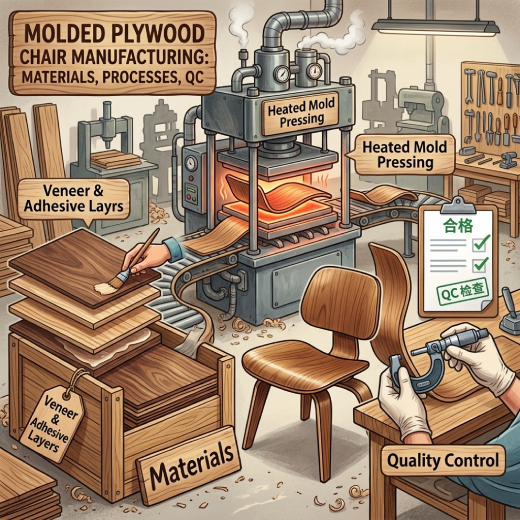
Molded Plywood Chair Manufacturing: Materials, Molding Processes and Quality Control
Latest Blog