
NEWS
Data is empty
Molded Plywood Chair Manufacturing: Materials, Molding Processes and Quality Control
Molded plywood has become an important material in modern furniture manufacturing because it allows manufacturers to produce lightweight, curved, and structurally efficient furniture components. From dining chairs and lounge seating to commercial office furniture, its ability to combine ergonomic shapes with engineered wood construction makes it suitable for various furniture applications.
However, producing a reliable molded plywood chair involves more than pressing several layers of veneer into a curved mold. Material selection, adhesive compatibility, veneer arrangement, mold geometry, pressing conditions, and post-molding stabilization all influence the final product.
1. What Materials Are Used in Molded Plywood Chair Manufacturing?
1.1 Which Wood Veneers Are Suitable for Molded Plywood?
The quality of moulded plywood starts with veneer selection. Common materials include birch, poplar, beech, and other hardwood or softwood veneers. Their flexibility, density, grain characteristics, and bonding properties influence molding performance.
| Veneer material | Main characteristics | Manufacturing considerations |
| Birch | Dense, uniform, and relatively strong | Suitable for structural components |
| Poplar | Lightweight and easy to process | Useful for weight and cost control |
| Beech | Good strength and attractive grain | Requires careful moisture control |
| Other hardwood veneers | Different strength and appearance profiles | Depends on species and availability |
Veneer thickness is another important variable. Thin veneers generally conform more easily to complex curves, while thicker layers may require greater forming pressure and careful mold design.
1.2 How Do Adhesives Affect Molded Plywood Strength?
Adhesive selection directly affects bonding strength, moisture resistance, curing behavior, and production efficiency.
Common adhesive systems include urea-formaldehyde, phenolic resins, and other thermosetting or furniture-grade bonding systems. The appropriate choice depends on the intended application, curing conditions, emission requirements, and environmental exposure.
Three factors require particular attention:
- Adhesive distribution: Uneven glue application creates weak bonding areas.
- Open assembly time: Excessive delays between glue application and pressing can affect adhesion.
- Curing conditions: Temperature and pressure must support complete adhesive curing throughout the veneer layers.
A molded plywood chair may appear visually acceptable immediately after pressing, but incomplete curing can cause delamination during subsequent machining or long-term use.
2. How Does the Molded Plywood Manufacturing Process Work?
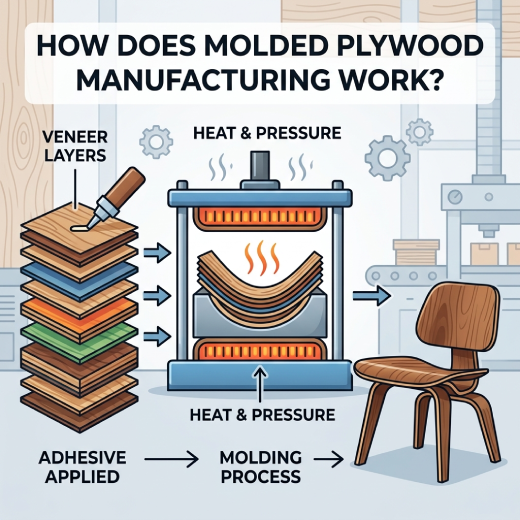
2.1 What Are the Main Steps in Molding Curved Plywood?
The production of molded plywood involves several coordinated operations.
Unlike flat plywood production, curved molding requires the veneer layers to deform while maintaining sufficient contact with each other. The mold must therefore control both the final geometry and the distribution of pressure.
2.2 Why Are Mold Design and Pressing Parameters So Important?
Mold design determines the final curvature, thickness distribution, and dimensional accuracy of the finished component.
A poorly designed mold may create uneven pressure, resulting in wrinkles, weak bonding, or excessive thinning around tight curves.
Manufacturers should consider:
- Mold radius and transition geometry.
- Veneer thickness and total lay-up thickness.
- Pressure distribution across the entire surface.
- Heating uniformity and adhesive curing requirements.
- Pressing time relative to material thickness.
2.3 What Causes Springback and Deformation After Molding?
Springback refers to the tendency of molded wood components to partially recover toward their original shape after being released from the mold.
It is influenced by wood's natural elastic behavior, veneer moisture content, curvature, adhesive curing, and internal stresses.
Common control methods include:
1. Maintaining consistent veneer moisture content.
2. Optimizing veneer orientation and layer arrangement.
3. Allowing sufficient curing and stabilization time.
4. Adjusting mold geometry based on measured production results.
5. Checking dimensions after conditioning rather than immediately after demolding.
For manufacturers producing large quantities of molded plywood chair components, springback control is essential because small dimensional changes can affect assembly accuracy and the appearance of finished furniture.
3. What Quality Control Measures Ensure Reliable Molded Plywood Production?
3.1 What Are the Most Common Manufacturing Defects?
Even with modern molding equipment, several defects can occur during production.
| Common defect | Possible causes | Recommended control measures |
| Delamination | Poor adhesive distribution or incomplete curing | Monitor bonding and press conditions |
| Surface wrinkles | Uneven veneer deformation | Improve lay-up and mold design |
| Cracking | Excessive bending stress or unsuitable veneer moisture | Adjust veneer selection and curvature |
| Springback | Residual stress and insufficient stabilization | Improve conditioning and mold compensation |
| Uneven thickness | Inconsistent veneer layers or pressure | Control lay-up and mold alignment |
| Surface discoloration | Excessive heat or adhesive-related staining | Optimize temperature and finishing |
One important industry problem is that some defects only become visible after machining or finishing. For example, weak internal bonding may not be noticeable on the outer surface but can become apparent when edges are trimmed or mounting holes are drilled.
3.2 How Should Manufacturers Build a Quality Inspection System?
Incoming inspection: Check veneer thickness, moisture content, visible defects, and adhesive specifications.
In-process inspection: Monitor glue application, lay-up consistency, mold alignment, temperature, pressure, and pressing time.
Post-molding inspection: Measure curvature, thickness, dimensional accuracy, and surface condition after stabilization.
Final inspection: Evaluate bonding integrity, drilling accuracy, finish quality, and compatibility with supporting hardware.
3.3 How Does Molded Plywood Quality Affect Finished Office Chairs?
A molded plywood seat or backrest rarely works independently. Its performance depends on the supporting frame, mounting hardware, armrests, and other furniture components.
For example, inaccurate mounting-hole positions can create assembly stress, while inconsistent backrest curvature can affect seating comfort.
This is particularly relevant to integrated moulded plywood office furniture manufacturing. FSGROWING, also called Foshan Growing Furniture Co., Ltd., established in 2010 and headquartered in Jiujiang, Foshan, operates multiple factories covering more than 10,000 square meters, with approximately 150 employees.
The company locates its factories close to raw material sources to improve production specialization and manufacturing efficiency. It has independent design, production, and sales departments, as well as plastic production and hardware workshops.
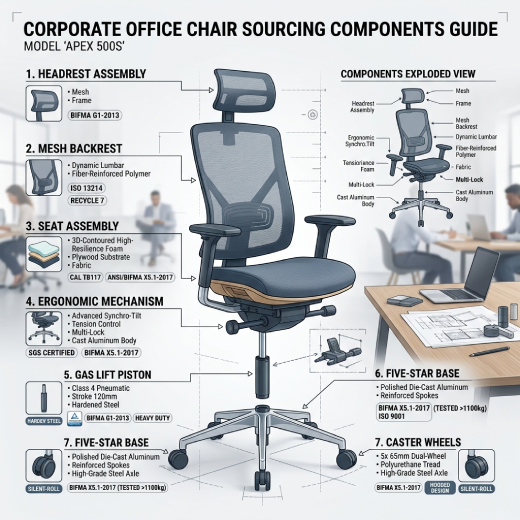
These specialized workshops work together to produce office chair components, including casters, chair bases, gas lift cylinders, mechanism plates, seat shells, backrests, headrests, and armrests.
This manufacturing arrangement illustrates an important industry principle: the quality of a finished chair depends not only on individual components but also on dimensional coordination and compatibility between different production processes.
4. How Should B2B Buyers Evaluate Molded Plywood Manufacturers?
4.1 What Should Importers Check Before Placing Bulk Orders?
| Evaluation factor | Questions buyers should ask |
| Material sourcing | What veneer species and thicknesses are available? |
| Molding capability | Can the supplier produce complex and consistent curves? |
| Adhesive system | What bonding system and curing process are used? |
| Quality control | How are delamination and springback detected? |
| Customization | Can molds and dimensions be adjusted for new designs? |
| Production capacity | Can specifications remain consistent across bulk batches? |
4.2 Industry Pain Points: Frequently Asked Questions
Q1: Why does molded plywood delaminate after several months of use?
Possible causes include inadequate adhesive application, incomplete curing, excessive moisture exposure, or weak veneer surfaces. Buyers should investigate the bonding process rather than relying only on visual inspection.
Q2: Can manufacturers produce different curves using the same mold?
Not necessarily. Mold geometry determines the final shape. Different curvature requirements may require modified tooling, adjusted lay-up thickness, or redesigned pressing conditions.
Q3: Why does a molded plywood chair become distorted after demolding?
Springback and residual internal stress are common causes. Moisture inconsistency and insufficient stabilization can make dimensional changes more pronounced.
Q4: How can buyers evaluate molded plywood bonding quality?
They can request relevant bond-strength or durability test results and inspect samples for visible separation. Testing should be appropriate for the adhesive system and intended application.
Q5: Is a higher number of veneer layers always better?
No. The correct layer configuration depends on the required thickness, curvature, stiffness, and manufacturing method. Poorly arranged layers can create unnecessary production costs without improving structural performance.
4.3 What Are the Future Opportunities in Molded Plywood Manufacturing?
The industry is moving toward more efficient material utilization, automated pressing, improved adhesive systems, and greater customization of furniture shapes.
For commercial furniture buyers, the most important consideration is not simply whether a supplier can produce a curved component, but whether that supplier can maintain its geometry, bonding quality, and dimensional consistency across repeated production batches.
Successful moulded plywood manufacturing requires coordinated control of veneer selection, adhesive application, mold design, pressing conditions, and quality inspection. If you are developing molded seating products or sourcing office chair components with an experienced furniture manufacturer, such as FSGROWING, can help establish a more reliable production process.
Industrial Seating Solutions: How to Choose Durable, Ergonomic and Cost Effective Chair Components for Industrial Workspaces
Plywood Chair: Types, Materials, Structure and Commercial Applications
Related blog
Latest Blog