
NEWS
Data is empty
Importance of Office Chair Bases and Its Types
An office chair base is often hidden beneath the seat, yet it has a direct influence on stability, mobility, load distribution, and overall chair durability. When an office chair becomes unstable, develops excessive movement, or experiences caster-related failures, the base is one of the components that deserves careful inspection.
Choosing an office chair base is not simply a matter of appearance. Understanding the different types of chair bases can therefore help buyers make better decisions when selecting a new chair or planning a chair base replacement.
Why Is an Office Chair Base So Important to Chair Stability and Safety?
What does an office chair base actually do?
The primary function of an office chair base is to provide a stable foundation between the chair mechanism and the floor.
Most mobile office chairs use a five-star configuration because five support arms distribute the user's weight across multiple points while providing a broad footprint. The base also provides mounting locations for casters, allowing the chair to roll while maintaining its center of gravity.
This creates several interconnected functions:
Supporting the user's weight
Distributing dynamic loads
Maintaining chair stability
Connecting the gas lift to the floor structure
Supporting caster movement
Enabling 360-degree chair mobility
Reducing excessive tipping tendencies
The importance of the base becomes particularly obvious when the chair is reclined or when the user shifts their body weight. The load is no longer distributed vertically. Instead, forces are transferred through the mechanism, gas lift, center hub, base arms, and casters.
Therefore, a base that looks visually attractive but has inadequate structural strength can still become a significant failure point.
Does a wider office chair base provide better stability?
Generally, a larger footprint can improve resistance to tipping because the support points are distributed farther from the center.
However, “larger is always better” is not an engineering rule.
Base diameter must be considered together with:
Chair seat height
Gas lift stroke
Seat dimensions
User weight
Reclining angle
Caster diameter
Chair center of gravity
Intended application
For example, a high-back executive chair with a higher seat position may require a different stability strategy than a compact task chair.
The base therefore needs to be designed as part of the complete chair system rather than selected independently.
Why does the connection between the base and gas lift matter?
The center hub of the base carries concentrated loads from the gas lift. Poor dimensional control at this connection can result in looseness, abnormal movement, or difficulty during assembly.
This is especially important when replacing an existing base. A visually similar chair base replacement may still be unsuitable if its center connection does not match the gas lift or chair mechanism.
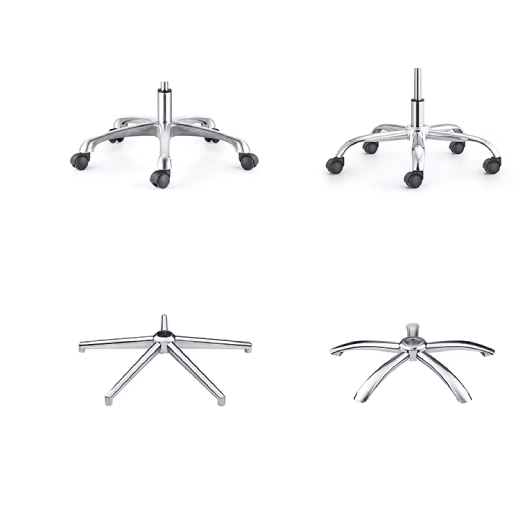
What Are the Main Types of Office Chair Bases and How Do They Differ?
Is a nylon office chair base suitable for everyday commercial use?
Nylon is one of the most widely used materials for office chair bases because it combines relatively low weight, manufacturability, and cost efficiency.
Glass-fiber-reinforced nylon can provide substantially greater structural performance than ordinary plastic. The reinforcement improves stiffness and load-bearing characteristics, making engineered nylon suitable for many task chairs and commercial seating applications.
Its main advantages include:
Low weight
Efficient injection molding
Good impact resistance
Corrosion resistance
Competitive production cost
Easy integration into mass production
However, material formulation matters. Simply specifying “nylon” does not fully describe the mechanical performance of the finished base.
The resin grade, glass-fiber content, geometry, wall thickness, molding conditions, cooling, and dimensional consistency can all influence performance.
When should you choose a chrome-plated metal office chair base?
Chrome-plated metal bases are commonly selected when buyers want a combination of structural strength and a bright metallic appearance.
A typical chrome base uses a metal structure with a chrome-plated surface. The plating provides the characteristic reflective finish and can improve resistance to surface wear and corrosion when properly manufactured.
Chrome bases are particularly suitable for:
Executive chairs
Premium office furniture
Conference seating
Hospitality furniture
Designs requiring a polished metallic appearance
However, buyers should distinguish the chrome finish from the underlying structural material.
A highly polished surface does not automatically mean that the base has superior load performance. Tube thickness, steel quality, welding quality, hub construction, and connection design can have a much greater impact on structural integrity.
Why are aluminum office chair bases considered a premium option?
Aluminum alloy bases offer an attractive strength-to-weight balance and are frequently used in premium ergonomic and executive seating.
Compared with conventional steel structures, aluminum can provide lower weight while maintaining strong structural performance. It also naturally forms an oxide layer that contributes to corrosion resistance.
Typical finishing options include:
Polished aluminum
Brushed aluminum
Anodized finishes
Other decorative surface treatments
The main limitation is cost. Die casting, finishing, polishing, machining, and quality control can make aluminum bases more expensive than nylon alternatives.
Therefore, aluminum is most valuable when the product positioning justifies the additional material and manufacturing investment.
Are all five-star swivel chair bases the same?
No.
The five-star configuration describes the basic geometry, not the complete specification.
Two five-star bases can differ in:
Diameter
Arm geometry
Center hub design
Material
Caster socket dimensions
Gas-lift connection
Wall thickness
Weight
Surface treatment
A swivel chair base should therefore be evaluated according to the chair's complete configuration rather than by the number of arms alone.
What Should Buyers Check When Choosing or Replacing an Office Chair Base?
What dimensions should be checked before ordering a chair base replacement?
Before purchasing a replacement, buyers should verify more than the external diameter.
At minimum, check:
1. Overall base diameter
2. Center connection dimensions
3. Gas lift compatibility
4. Caster stem size
5. Caster socket configuration
6. Base height
7. Material
8. Required load performance
9. Surface finish
10. Installation method
Caster compatibility is particularly important.
A replacement base can appear correct but become unusable if the caster stems do not fit securely into the sockets. Conversely, forcing an incompatible caster into a socket can create looseness or damage.
Should office chair buyers focus on maximum load capacity?
Load capacity matters, but maximum static load should not be the only purchasing criterion.
An office chair experiences dynamic loading every day. Users sit down, lean backward, move sideways, recline, rotate, and adjust their seating position. These movements create forces that differ from a simple vertical load test.
Therefore, buyers should consider:
Static load
Dynamic loading
Repeated loading
Impact conditions
User movement
Expected service life
Environmental conditions
A base intended for a shared commercial office may experience dramatically more cycles than a chair used occasionally in a home office.
This is why durability testing and manufacturing consistency are important indicators of product quality.
What causes an office chair base to crack or fail prematurely?
Several factors can contribute to base failure.
For molded nylon bases, insufficient material strength, poor formulation, inadequate reinforcement, molding defects, stress concentration, or prolonged environmental exposure can become potential concerns.
For metal bases, common issues include:
Insufficient wall thickness
Poor welding
Casting defects
Inadequate material composition
Excessive stress concentration
Poor finishing or corrosion protection
The geometry is equally important. The transition between the center hub and individual arms is a high-stress area because loads are transferred from the central gas lift into the five supporting arms.
A good base is therefore not simply made from a “strong material.” It must combine appropriate material selection with structural geometry and controlled manufacturing.
Industry FAQ: What Problems Do Buyers Often Overlook?
Can I use any five-star base as a replacement?
No. The five-star configuration alone does not guarantee compatibility. Center connection, caster sockets, diameter, dimensions, and load requirements must all match.
Is an aluminum base always stronger than a nylon base?
Not automatically. Strength depends on material formulation, geometry, manufacturing quality, and design. A properly engineered reinforced nylon base can perform very well in its intended application.
Why does my replacement office chair base wobble?
Possible causes include an incompatible gas-lift connection, incorrect center dimensions, loose caster installation, damaged components, or insufficient fit between the base and other chair components. The entire connection system should be checked.
Does a heavier office chair base mean better quality?
Not necessarily. Weight can indicate material choice, but it is not a direct measure of structural performance. Engineering design, material properties, manufacturing precision, and testing are more meaningful indicators.
When should I replace the entire base instead of repairing it?
If the base has structural cracks, broken caster sockets, severe deformation, or permanent damage around the center hub, replacement is generally more appropriate than attempting a repair.
What information should B2B buyers provide when requesting an office chair base?
Provide the required base diameter, material preference, caster specification, gas-lift connection, expected load, application, finish, and target quantity. A technical drawing or physical sample can significantly reduce compatibility problems.

Latest Blog