
NEWS
Data is empty
Heavy Duty Casters for Commercial Use: How to Choose Strong Chair Casters
Heavy duty casters for commercial use are essential components in office chairs, conference seating, and other commercial furniture. Choosing the right casters affects load capacity, rolling performance, floor protection, product durability, and after-sales costs.
However, not all heavy duty caster wheels are designed for the same application. Some prioritize load-bearing capacity, while others focus on quiet movement, wear resistance, or compatibility with different office chair bases. Understanding these differences helps B2B buyers select heavy duty chair wheels that meet their product requirements without unnecessary costs.
1. What Are Heavy Duty Casters for Commercial Use?
Heavy duty industrial caster wheels chair are mobility components designed to withstand demanding loading and operating conditions. In office furniture, they must support the combined weight of the chair and occupant while handling repeated movement, directional changes, and continuous contact with the floor.
A complete office chair caster typically includes a wheel, hub, axle, bearing, swivel housing, and mounting stem. Each component contributes to overall performance.
What makes strong chair casters different from standard office chair wheels?
The main differences involve structural design, material selection, load rating, and durability. Strong chair casters need more than a thick wheel tread. The axle must resist deformation, the hub must maintain structural integrity, and the stem must remain securely connected to the chair base.
For commercial seating, buyers should evaluate:
- Load capacity: The maximum load supported under specified test conditions.
- Wheel durability: Resistance to wear, cracking, and deformation.
- Rolling performance: The force required to start and maintain movement.
- Swivel performance: The ability to change direction without excessive resistance.
- Mounting compatibility: Correct stem dimensions and retention.
- Service life: Performance under repeated loading and movement.
A caster with a high nominal load rating may still fail prematurely if its mounting stem, bearing, or swivel assembly is poorly designed.
2. Nylon vs. PU vs. Rubber: Which Heavy Duty Chair Wheels Are Best?
Wheel material influences load performance, noise, rolling resistance, and floor protection. The best option depends on the intended application rather than material name alone.
| Comparison factor | Nylon caster wheels | PU caster wheels | Rubber caster wheels |
| Hardness | Generally high | Varies by formulation | Generally softer |
| Rolling resistance | Often low on suitable surfaces | Generally balanced | Can be higher |
| Noise | Can be relatively noisy | Usually quieter than hard nylon | Good noise absorption |
| Floor protection | Depends on floor type | Often suitable for hard floors | Good cushioning; marking depends on formulation |
| Wear resistance | Depends on material grade and design | Often good under suitable conditions | Varies with compound and operating environment |
| Typical applications | Selected hard-floor and industrial applications | Office chairs and commercial seating | Noise-sensitive and cushioning applications |
2.1 Are nylon and PU heavy duty chair wheels suitable for commercial offices?
Nylon wheels can offer high hardness and low rolling resistance, but they may be less suitable for noise-sensitive environments or delicate flooring.
Polyurethane (PU) wheels provide a useful balance of wear resistance, rolling performance, and floor protection. They are often considered for offices, conference rooms, and commercial furniture used on hard flooring.
Rubber wheels can reduce noise and absorb minor surface irregularities, although their rolling resistance and wear characteristics depend on the formulation.
For B2B procurement, the key question is whether the wheel material performs consistently under the expected load, floor conditions, and movement frequency.
2.2 What are the advantages of heavy duty nylon and PU caster wheels?
A nylon wheel structure combined with a PU tread can offer the benefits of a rigid wheel body and a resilient contact surface. However, constructions vary by product, so buyers should confirm the actual material composition.
When comparing strong chair casters, evaluate the complete assembly rather than assuming that a particular material guarantees higher load capacity or longer service life.
3. How Do Wheel Diameter, Bearings, and Stems Affect Caster Performance?
3.1 Are larger heavy duty chair wheels better for commercial use?
Larger wheel diameters generally help casters pass over small floor joints and surface irregularities. They may also reduce the effort required to initiate movement in suitable applications.
However, larger wheels increase the overall caster height and may interfere with the chair base, floor clearance, or surrounding components. Changing wheel diameter can also alter the seat height.
Before selecting larger heavy duty chair wheels, verify the available clearance, chair geometry, and compatibility with the existing base.
3.2 Which bearing type is best for heavy duty caster wheels?
Bearing selection affects rolling resistance, durability, and maintenance requirements.
- Plain bearings: Simple construction that may suit cost-sensitive applications.
- Ball bearings: Can provide low friction when properly designed and installed.
- Other engineered bearing systems: May be suitable for specific loading and operating conditions.
The correct choice depends on the caster's intended load, operating frequency, and cost targets. Buyers should also inspect axle tolerances and hub alignment because poor dimensional control can cause wobbling or uneven rotation.
3.3 Why do commercial office chair casters become difficult to move?
Common causes include worn bearings, debris around the axle, damaged swivel components, loose mounting stems, and unsuitable wheel materials.
It is important to distinguish rolling resistance from swivel resistance. If the wheel itself does not rotate smoothly, the problem may involve the axle or bearing. If the caster rolls but resists changing direction, the swivel mechanism may require inspection.
Replacing the entire caster without identifying the failure mechanism can lead to repeated maintenance costs.
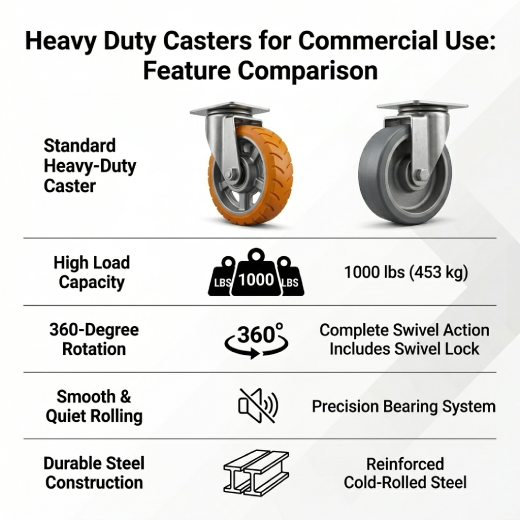
4. How to Select Industrial Caster Wheels for Chair Applications
The term industrial caster wheels chair may refer to heavy-duty mobility components used in demanding furniture or industrial seating environments. However, industrial caster wheels chair designed for carts and machinery are not automatically suitable for office chairs.
Industrial equipment may experience shock loading, rough floors, longer travel distances, and higher sustained loads. Office chair casters have different requirements involving swivel movement, mounting stems, chair-base geometry, and floor protection.
4.1 How should B2B buyers calculate caster load capacity?
Buyers should consider the total intended load, number of supporting casters, load distribution, and the manufacturer's rating methodology.
A simple division of total weight by the number of wheels does not account for uneven loading, movement, or impact. The selected rating should therefore be verified against the applicable test conditions and the complete chair design.
4.2 What should importers inspect before bulk ordering strong chair casters?
Before approving production, confirm the following:
1. Dimensions: Stem diameter, stem length, wheel diameter, and overall height.
2. Material specifications: Nylon grade, PU formulation, or other material details.
3. Load performance: Documented capacity and relevant test conditions.
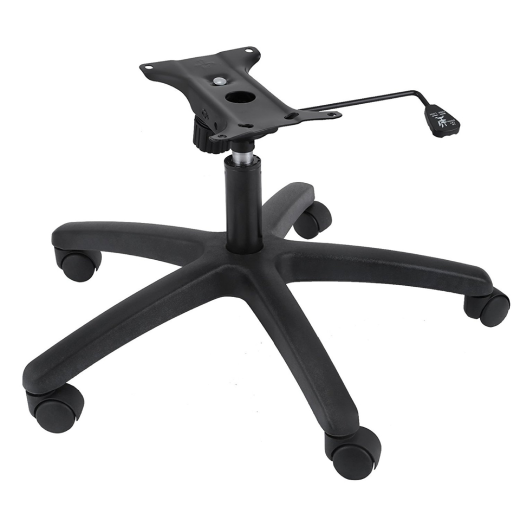
4. Assembly compatibility: Fit with the intended office chair base.
5. Quality consistency: Dimensional tolerances, surface defects, and assembly integrity.
6. Packaging and logistics: Protection against damage during transport and storage.
5. How Do Heavy Duty Casters Affect Total Procurement Costs?
The purchase price is only one part of caster cost. B2B buyers should also consider freight, assembly labor, replacement frequency, warranty claims, and customer complaints.
Lightweight wheels may help reduce shipping weight, but the savings must be balanced against product performance. Similarly, a lower cost industrial caster wheels chair may become more expensive if inconsistent dimensions cause assembly delays or if premature failures increase replacement costs.
For large volume industrial caster wheels chair orders, buyers should establish a documented product specification and use the approved sample as the reference for mass production. Material substitutions and dimensional changes should be reviewed before implementation.
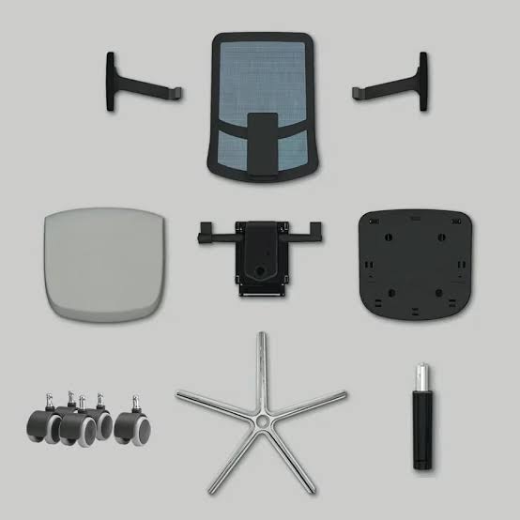
FSGROWING's specialized workshops work together to produce different office chair components, including casters, chair bases, gas lift cylinders, mechanism plates, seat shells, backrests, headrests, armrests, and more. This broader component range is relevant when buyers need to evaluate caster compatibility alongside the other structural components of an office chair.
6. FAQ: Heavy Duty Casters for Commercial Use
What is the difference between heavy duty chair wheels and industrial caster wheels?
Heavy duty chair wheels are designed around chair-specific requirements, including swivel movement, stem mounting, and compatibility with office chair bases. Industrial caster wheels may be engineered for higher loads, shock resistance, or rougher operating conditions. Their specifications should not be considered interchangeable.
Are PU caster wheels better than nylon wheels for office chairs?
PU wheels are often preferred where quiet movement and floor protection matter. Nylon wheels may be appropriate where hardness and low rolling resistance are priorities. The final decision depends on the floor surface, load, wheel design, and operating conditions.
Why do strong chair casters break under normal use?
Possible causes include poor material quality, stress concentrations, repeated impacts, uneven loading, defective bearings, or an incompatible mounting connection. Buyers should inspect the failed component and surrounding assembly before changing the load rating.
How can buyers prevent office chair caster compatibility problems?
Confirm stem dimensions, retention design, wheel diameter, overall height, and chair-base socket specifications before ordering. Visual similarity alone does not guarantee a secure fit.
What documents should suppliers provide for heavy duty caster wheels?
Depending on the application, buyers may request dimensional drawings, material specifications, load-rating information, relevant test reports, inspection criteria, and batch traceability records. Requirements should be agreed upon before mass production.
Are heavy duty casters always more expensive than standard chair wheels?
Not necessarily. Cost depends on materials, construction, dimensions, testing requirements, order volume, and manufacturing processes. Buyers should compare total procurement costs and expected service life rather than price alone.
When evaluating heavy duty chair wheels for a new product range, compare wheel materials, dimensions, load requirements, and chair-base compatibility. FSGROWING's office chair component range provides a starting point for discussing caster selection alongside related seating components and sourcing requirements.
Latest Blog