
NEWS
Data is empty
How Bent Plywood Technology Creates Strong and Ergonomic Chair Structures
Bent plywood chair technology has transformed modern furniture manufacturing by making it possible to create lightweight, durable, and ergonomically shaped seating structures. By bonding multiple thin wood veneers and pressing them into carefully engineered molds, manufacturers can produce complex curves that are difficult to achieve with conventional solid wood processing.
1. What Makes Bent Plywood Technology Suitable for Strong and Ergonomic Chair Structures?
1.1 How does laminated veneer construction improve chair strength?
A bent plywood chair is manufactured by bonding several thin wood veneers into a single structural component. Unlike solid wood, which has relatively consistent grain direction, plywood typically uses alternating veneer orientations to distribute loads across multiple directions.
This cross-laminated construction provides several advantages for bent plywood chair:
- Improved dimensional stability: Alternating grain directions help reduce the effects of uneven shrinkage, expansion, and warping.
- Load distribution: Multiple bonded layers distribute mechanical stress rather than concentrating it along one grain direction.
- High strength-to-weight ratio: Thin veneers create a relatively lightweight structure without requiring excessively thick solid timber.
- Design flexibility: Laminated sheets can be formed into curved surfaces, including seat shells, backrests, and armrests.
A curved plywood chair can therefore combine structural efficiency with a visually continuous design. However, the final strength depends on veneer species, thickness, adhesive quality, layer arrangement, and pressing conditions.
1.2 Why does curved geometry improve structural performance?
Curvature is not simply an aesthetic feature. It changes how a component responds to mechanical loads.
A flat plywood panel primarily resists bending through its section thickness. When formed into a curved shell, the geometry can increase structural stiffness and distribute forces across a wider area. The resulting structure may resist deformation more effectively than a comparable flat panel, depending on its shape, support conditions, and loading direction.
For example, a curved seat shell can distribute occupant weight across its surface, while a shaped backrest can provide more continuous contact with the user's back.
2. How Is Curved Plywood Manufactured? Materials, Molding and Quality Control
2.1 What are the main manufacturing steps?
Producing a curved ply component requires precise coordination between material preparation, adhesive application, mold design, and pressing.
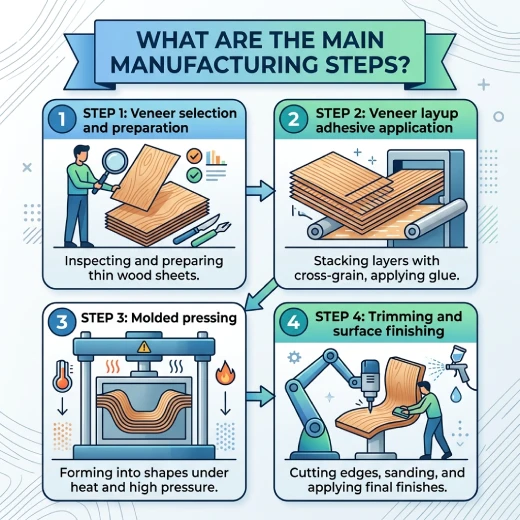
Step 1: Veneer selection and preparation
Common veneer materials include birch, beech, poplar, and other suitable wood species. Selection depends on strength requirements, appearance, availability, and cost.
Manufacturers inspect veneer thickness, grain consistency, surface defects, and moisture content. Uneven moisture levels can cause dimensional instability and bonding problems.
Step 2: Veneer layup and adhesive application
Multiple veneer layers are arranged according to a specified grain orientation. Cross-oriented layers help improve dimensional stability, while the face veneers may be selected primarily for appearance.
Adhesive must be distributed uniformly. Insufficient adhesive can produce weak bonding, while excessive adhesive may cause uneven glue lines or unnecessary material costs.
Step 3: Molded pressing
The prepared layers are placed inside matched molds and subjected to controlled pressure, temperature, and pressing time.
Mold geometry determines the final curvature. Tooling accuracy is especially important for components that must fit precisely with metal frames, armrests, or other furniture parts.
Step 4: Trimming and surface finishing
After pressing and curing, the component is removed, trimmed, sanded, and finished. Depending on product requirements, manufacturers may apply paint, clear coatings, decorative veneer, or other surface treatments.
| Manufacturing factor | Potential problem | Recommended quality control |
| Veneer moisture content | Warping and dimensional changes | Incoming moisture inspection |
| Veneer thickness | Uneven structural properties | Thickness measurement |
| Adhesive distribution | Delamination and weak bonding | Glue application monitoring |
| Pressing temperature and pressure | Incomplete bonding or deformation | Process parameter records |
| Mold accuracy | Inconsistent curvature | Mold inspection and dimensional checks |
| Surface finishing | Cracks, scratches, and uneven coatings | Visual and adhesion inspection |
One important industry challenge is veneer checking. Small cracks can develop when moisture changes create differential shrinkage between the face veneer and underlying layers. Poor material matching and unsuitable finishing conditions can increase this risk.
Another concern is delamination, particularly when adhesive selection, bonding pressure, or curing conditions are poorly controlled.
For a curved plywood chair, quality inspection should therefore extend beyond visual appearance. Manufacturers need to verify structural integrity, dimensional consistency, bonding performance, and compatibility with the complete bent plywood chair assembly.
3. How Does Curved Plywood Support Ergonomics and Commercial Furniture Performance?
3.1 Can molded plywood improve seating comfort?
Ergonomic performance depends on the relationship between the bent plywood chair structure and the human body. A properly designed curved plywood chair can support this relationship through three-dimensional shaping.
First, a contoured seat can distribute body weight more evenly than an unsuitable flat surface. Second, a curved backrest can follow the general shape of the user's back, improving contact and reducing unsupported areas. Third, appropriately positioned side curves can provide a degree of lateral support.
However, curvature alone does not guarantee ergonomic comfort. Seat depth, seat height, backrest angle, lumbar support, and user anthropometry must also be considered.
| Structural design | Main advantages | Limitations | Typical applications |
| Flat plywood panel | Simple production and relatively low tooling complexity | Limited contouring flexibility | Basic seating and furniture panels |
| Bent laminated plywood | Lightweight, strong, and suitable for compound shapes | Requires controlled lamination and molding | Lounge chairs and dining chairs |
| Solid wood bending | Natural grain appearance and traditional construction | Species-dependent bending limitations | | Classic wooden furniture |
| Molded plastic shell | Flexible geometry and scalable mass production | Material behavior and surface appearance differ from wood | Office and public seating |
A curved plywood chair is particularly suitable for furniture designs that require a balance between natural material appearance, structural performance, and ergonomic shaping. Nevertheless, commercial buyers should distinguish between decorative shells and load-bearing components.
3.2 What performance tests should furniture manufacturers prioritize?
For a bent plywood chair, structural validation should consider the complete seating system rather than testing only the plywood component.
Relevant evaluations include:
- Static loading tests for seats and backrests.
- Repeated loading tests to assess fatigue and long-term durability.
- Stability testing under different loading conditions.
- Bond integrity and delamination inspection.
- Dimensional verification after production and conditioning.
- Surface coating resistance and environmental suitability.
4. What Should B2B Buyers Consider When Sourcing Curved Plywood Chair Components?
4.1 How can procurement teams evaluate manufacturers effectively?
Sourcing curved ply components involves more than comparing unit prices. Buyers should examine whether a manufacturer can consistently reproduce the specified geometry, maintain bonding quality, and meet the required production volume.
Important evaluation criteria include:
1. Material traceability: Confirm veneer species, thickness, adhesive specifications, and material consistency.
2. Manufacturing capability: Review molding equipment, tooling accuracy, and production process control.
3. Sample verification: Test initial samples for dimensions, surface quality, assembly compatibility, and structural performance.
4. Batch consistency: Check whether production tolerances and inspection procedures remain consistent across large orders.
5. Supply chain coordination: Evaluate the manufacturer's ability to coordinate wooden components with metal and plastic chair parts.
A frequent procurement problem is that a plywood shell passes an individual inspection but fails during final assembly.
Therefore, buyers should provide technical drawings, tolerance requirements, load specifications, and assembly references before mass production.
4.2 How does FSGROWING's manufacturing structure support furniture component production?
Foshan Growing Furniture Co., Ltd. (FSGROWING) operates multiple factories covering more than 10,000 square meters, with approximately 150 workers.
Its multi-factory arrangement places production facilities close to raw material sources, helping improve production specialization and cost competitiveness.
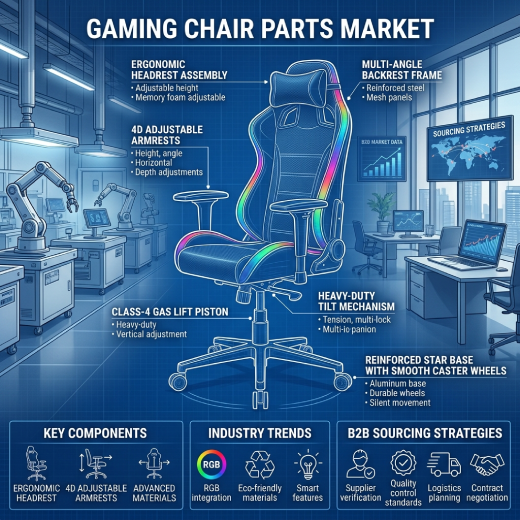
FSGROWING has its own design, production, and sales departments, together with dedicated plastic production and hardware workshops. These facilities manufacture various office chair components, including casters, chair bases, gas lift cylinders, mechanism plates, seat shells, backrests, headrests, and armrests.
4.3 FAQ: Common Technical and Procurement Questions
Q1: Is a bent plywood chair stronger than a traditional solid wood chair?
Not necessarily. Its strength depends on veneer quality, layer orientation, adhesive bonding, thickness, and structural design. Laminated construction offers better dimensional control in many applications, but properly selected and manufactured solid wood can also provide excellent strength.
Q2: Why do curved plywood components sometimes crack after production?
Common causes include unsuitable veneer moisture content, excessive bending stress, poor adhesive bonding, uneven pressing, and environmental moisture changes. Manufacturers should investigate whether cracks originate in the veneer, glue line, or surface coating before adjusting production parameters.
Q3: Does a curved plywood chair require more expensive tooling?
Generally, yes. Curved components require dedicated molds, accurate tooling, and process development. However, when production volume is sufficient, tooling costs can be distributed across larger batches. Buyers should compare total production costs rather than evaluating tooling expenses in isolation.
Q4: How can buyers prevent quality differences between production batches?
Establish approved reference samples, dimensional tolerances, material specifications, adhesive requirements, and documented inspection procedures. Periodic structural testing and batch traceability can help identify process deviations before they affect large shipments.
Q5: Is a curved ply seat suitable for long-term commercial use?
It can be, provided that its design, bonding system, surface finish, and complete chair assembly meet the intended usage requirements. Commercial buyers should request relevant strength and durability test reports rather than relying solely on appearance or material descriptions.
If you are developing office seating products or evaluating furniture component suppliers, FSGROWING can provide information about its office chair component manufacturing capabilities.
Related blog
Latest Blog