
NEWS
Data is empty
Metal vs Nylon Base Comparison: Which Office Chair Base Is Better for Your Business?
Choosing between a metal chair base and a nylon chair base involves more than comparing material strength or purchase price. The decision affects chair stability, product positioning, assembly efficiency, shipping costs, and long term warranty exposure.
Office chair metal base is often associated with structural rigidity and premium appearance, while reinforced nylon bases offer lightweight construction and manufacturing flexibility. However, neither material is automatically superior. The right choice depends on chair design, operating conditions, expected service life, and the quality of the complete component system.
1. What Is the Difference Between a Metal Chair Base and a Nylon Chair Base?
The first step is distinguishing between the material itself and the engineering of the finished component.
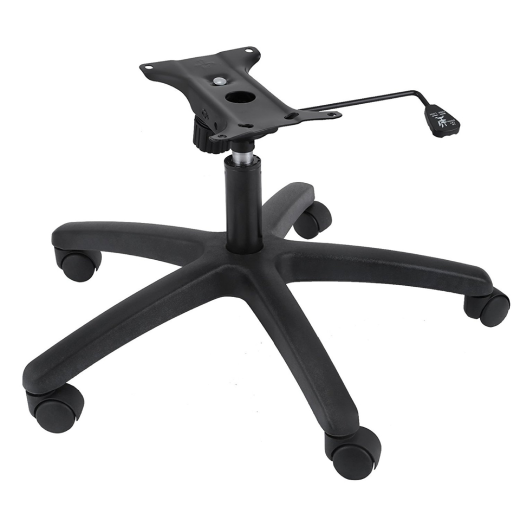
A metal chair base may be manufactured from aluminum or steel, with different manufacturing methods and surface treatments affecting its performance. A nylon chair base is commonly produced through injection molding, and some designs use glass-fiber reinforcement to improve stiffness and structural performance.
Unreinforced nylon and glass-fiber-reinforced nylon should not be treated as equivalent materials. Reinforcement changes the mechanical properties of the polymer, although actual performance still depends on resin grade, fiber content, molding quality, and component geometry.
Is an office chair metal base always stronger than a nylon base?
Metal generally offers greater rigidity, but strength is not determined by material alone. The thickness of the load-bearing sections, shape of the five-star legs, central hub design, and caster connections all influence structural performance.
A poorly designed metal base may develop problems around its central connection or caster sockets. Conversely, a properly engineered reinforced nylon base can provide reliable support in many everyday office seating applications.
For B2B buyers, the more useful question is whether the finished base meets the load, stability, and durability requirements of the intended chair.
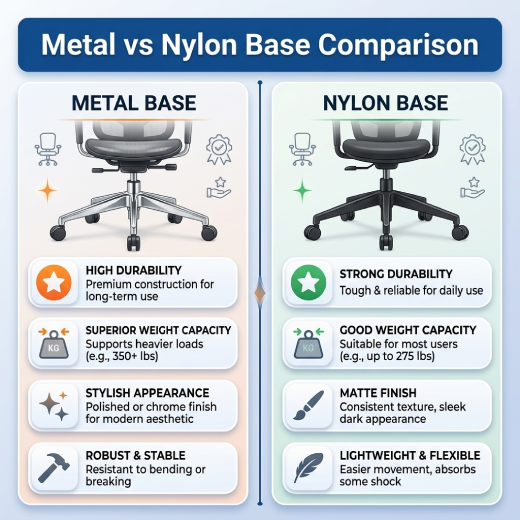
2. Metal vs Nylon Chair Base: Which Material Performs Better?
The following comparison highlights typical material characteristics. Actual results vary according to the specific alloy, polymer formulation, manufacturing process, and design.
| Comparison factor | Metal chair base | Nylon chair base |
| Structural rigidity | Generally high | Depends on reinforcement and geometry |
| Weight | Varies by metal and construction | Generally lightweight |
| Corrosion resistance | Depends on alloy and finish | Naturally resistant to rust |
| Manufacturing | Casting, forming, machining, or finishing | Commonly injection molding |
| Design flexibility | Depends on manufacturing method and tooling | Complex molded geometries can be practical |
| Surface appearance | Metallic, polished, plated, or coated finishes | Various molded colors and textures |
| Initial cost | | Depends on material, finish, and process | Often competitive for volume production |
| Shipping considerations | Depends on design and component weight | Lower weight may reduce shipping burden |
| Common considerations | Corrosion protection, finish quality, casting or forming defects | Material grade, reinforcement, molding consistency, deformation |
3. Is a Nylon Chair Base Suitable for Commercial Office Furniture?
A nylon chair base can be a practical choice for task chairs, high-volume office seating, and price-sensitive product ranges. Its relatively low weight and suitability for injection molding can support efficient production at scale.
3.1 Why does glass-fiber-reinforced nylon matter for chair base durability?
Glass fibers increase the stiffness of nylon and can improve its strength and dimensional stability when the material is correctly formulated and processed.
This is particularly relevant around the central hub, where the gas lift transfers loads into the five-star base, and around the legs, which transmit forces to the casters.
However, a higher reinforcement percentage does not automatically guarantee a better finished product. Fiber distribution, wall thickness, molding conditions, weld lines, and stress concentrations can all influence performance.
Buyers should request the actual material specification instead of accepting descriptions such as “heavy-duty plastic.”
3.2 What are the limitations of nylon chair bases?
Nylon components can be sensitive to sustained loading, temperature, moisture conditions, and material formulation. Poorly controlled molding or unsuitable geometry can increase the risk of deformation or cracking.
These risks become more important in intensive-use environments, including shared workstations, training rooms, and commercial seating installations.
The appropriate response is not to reject nylon outright, but to verify that the selected grade and design are suitable for the intended operating conditions.
4. How Do Chair Base Materials Affect Total Cost of Ownership?
The cheapest component is not necessarily the most economical choice over the product lifecycle.
For furniture brands and importers, total cost of ownership includes the purchase price, freight, assembly labor, inspection, warranty claims, replacement parts, and the potential cost of product recalls.
A lighter nylon base may reduce shipping weight, but any savings must be weighed against its purchase price and performance requirements. A metal base may support a premium retail price, yet additional finishing or protective treatment can increase production costs.
How can B2B buyers reduce chair base quality risks?
Start by defining the application and expected service conditions. Then evaluate the component using measurable specifications.
- Load and stability: Verify that the base is appropriate for the intended chair configuration and applicable testing requirements.
- Interface compatibility: Check the gas lift socket, caster stem dimensions, and required clearances.
- Material consistency: Request material specifications and batch-level quality documentation.
- Durability: Evaluate structural integrity under relevant static, dynamic, and cyclic loading tests.
- Surface quality: Inspect metal finishes for defects and molded nylon components for cracks, flash, and dimensional inconsistencies.
- Production repeatability: Confirm that samples and mass-produced parts maintain the same critical dimensions and performance.
A complete evaluation is more reliable than choosing a base solely because it is advertised as metal, aluminum, or reinforced nylon.
5. Why Must the Chair Base Be Evaluated with Other Office Chair Components?
A chair base does not operate independently. It connects the gas lift to the floor through the caster assembly, while the seat mechanism transfers forces from the upper chair structure into the cylinder.
A mismatch in any of these interfaces can cause assembly difficulties, excessive movement, or premature component wear.
For example, a well-made office chair metal base cannot compensate for an incompatible gas lift. Likewise, selecting durable nylon does not resolve poor caster fit or an unsuitable overall support footprint.
This is why component coordination matters during OEM and ODM development.
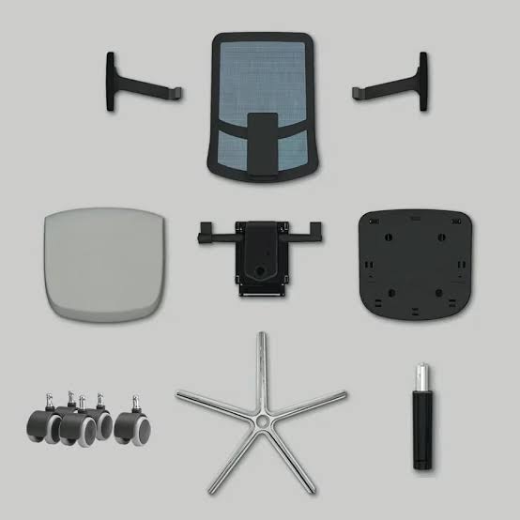
FSGROWING's specialized workshops work together to produce different office chair components, including casters, chair bases, gas lift cylinders, mechanism plates, seat shells, backrests, headrests, armrests, and more. This broader component range provides a relevant reference for buyers evaluating how individual parts fit into a complete office chair design.
6. FAQ: Common B2B Questions About Metal and Nylon Chair Bases
Does a metal chair base support more weight than a nylon base?
Not necessarily in every design. Load capacity depends on material grade, geometry, manufacturing quality, the central hub, and the complete chair configuration. Buyers should compare documented test results rather than relying on material names.
Can buyers replace a nylon base with a metal chair base?
Potentially, but the replacement must match the gas lift interface, caster connections, dimensions, clearances, and stability requirements. Similar appearance or a nominally compatible socket does not guarantee a safe replacement.
Which chair base material is more cost-effective for bulk purchasing?
Nylon may be attractive for high-volume products where weight and molding efficiency matter. Metal may be more appropriate when the product specification, appearance, or structural requirements justify its cost. Compare landed cost, expected defect rates, freight, and warranty exposure before making a purchasing decision.
What should importers request before approving a production sample?
Request dimensional drawings, material specifications, load and stability test information, interface measurements, surface-finish requirements, and agreed inspection criteria. Confirm that the approved sample represents the intended mass-production specification.
How should you choose between metal and nylon chair bases?
Choose a metal chair base when rigidity, finish, and product positioning justify the design and cost. Consider a nylon chair base when lightweight construction, molding flexibility, and competitive volume production are priorities. In both cases, verify material specifications, component compatibility, and actual test performance.
Latest Blog