
NEWS
Data is empty
Tips for Purchasing an Office Chair Gas Lift
An office chair gas lift is easy to overlook until the chair begins to sink, wobble, or lose its height adjustment. At that point, many buyers search for an office chair gas lift replacement and assume that any “universal” cylinder will work.
That assumption can create unnecessary compatibility problems.
Although many office chair gas cylinders share standardized connection dimensions, they are not identical in stroke, extended length, load capacity, activation method, surface treatment, and durability.
1. What Should You Check Before Buying an Office Chair Gas Lift?
Why does a standard-looking chair gas cylinder still require compatibility checking?
The first mistake buyers make is assuming that similar-looking cylinders have identical specifications.
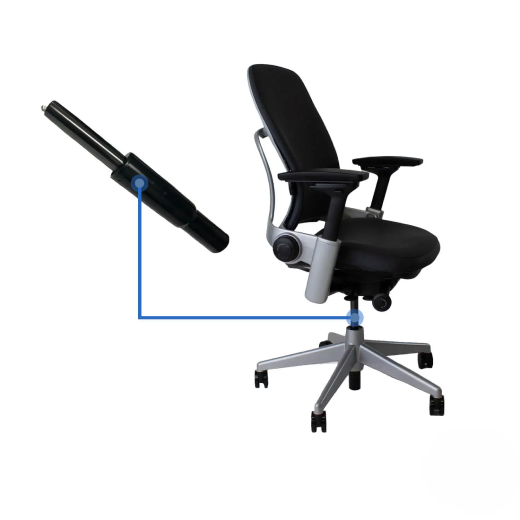
An office chair gas cylinder connects the five-star chair base to the seat mechanism and controls vertical movement through a pressurized pneumatic system. The replacement must therefore work mechanically with both connection points while providing the appropriate height range and load performance.
Before purchasing, check at least these specifications:
Cylinder outer diameter
Top and bottom connection dimensions
Stroke length
Fully compressed and extended length
Height range after installation
Load capacity or force rating
Activation mechanism
Cylinder class
Surface treatment
Applicable testing or certification requirements
Many replacement cylinders use approximately 50mm outer tubes and common tapered interfaces, but “universal” should never replace actual dimensional verification. Some chair models use proprietary mechanisms or unusual cylinder configurations.
How do you measure an office chair gas lift before ordering?
For a gas lift office chair replacement, measurement is more reliable than purchasing according to chair appearance or brand alone.
If the existing cylinder can still operate, measure the chair at its lowest and highest positions. The difference in the working height provides a useful indication of the required stroke.
The cylinder itself should also be checked for:
Overall extended length
Overall compressed length
Outer tube diameter
Piston rod diameter
Top fitting
Bottom fitting
Valve or activation configuration
The stroke is particularly important because it determines how much vertical adjustment the chair can provide. A cylinder that physically fits but has an unsuitable stroke can make the finished chair too high, too low, or incapable of achieving the intended ergonomic position.
What is the difference between an office chair gas lift and a chair gas cylinder?
The component is a sealed pneumatic assembly that uses compressed gas to provide controlled vertical movement. When the chair lever activates the valve, the cylinder allows controlled extension or compression. When the valve is released, the cylinder maintains the selected position.
This means the cylinder is simultaneously a height-adjustment component and a load-bearing functional component. A replacement should therefore be evaluated for both fit and performance.
2. How Do Stroke, Height Range, and Class Affect Gas Lift Selection?
Does a longer stroke always mean a better office chair gas lift?
No.
Stroke length determines the adjustment range, not overall product quality.
A longer-stroke cylinder may be appropriate for drafting chairs, high desks, specialized workstations, or chairs designed for users requiring a greater seat-height range. But installing an excessively long stroke into a conventional task chair can produce an ergonomically unsuitable seating height.
For example, a chair designed around a conventional desk may require a moderate adjustment range. Increasing the stroke without considering the seat mechanism, base geometry, desk height, and user posture can actually reduce usability.
What is the difference between Class 3 and Class 4 gas lifts?
Class is frequently used as a shorthand for the duty level of an office chair gas lift, but buyers should avoid treating the class number as a universal substitute for a complete technical specification.
Class 3 and Class 4 cylinders are commonly selected for office seating applications, with Class 4 generally positioned toward higher-duty applications.
The important point is that the class should be considered together with:
Rated load
Cycle requirements
Cylinder wall construction
Pressure-tube specifications
Application environment
Relevant testing requirements
Complete chair configuration
For a standard office environment, a properly specified Class 3 cylinder may be sufficient. For intensive commercial seating, heavier users, shared workstations, or applications involving frequent height adjustment, a higher-duty specification may be more appropriate.
The purchasing mistake is not choosing Class 3 instead of Class 4 automatically. The real mistake is selecting a class without defining the actual operating conditions.
Why should buyers consider cycle durability rather than only maximum load?
A chair gas cylinder experiences dynamic loading rather than one static load.
Every time a user sits down, stands up, adjusts the chair, or changes posture, the cylinder is exposed to changing forces. In shared offices, conference rooms, call centers, training facilities, and commercial environments, the number of adjustment cycles can be substantially higher than in a private home office.
Consequently, a cylinder's expected service life should not be evaluated solely by a headline load figure.
A better procurement question is:
How does the cylinder perform under the intended combination of load, adjustment frequency, environmental conditions, and service life requirements?
3. What Quality Factors Matter When Purchasing a Chair Gas Cylinder?
Why can two visually identical gas lifts have different service lives?
External appearance tells buyers very little about internal construction.
Two cylinders may have the same black or chrome exterior and appear interchangeable while differing in pressure-tube thickness, sealing components, piston design, internal tolerances, surface treatment, gas-pressure control, and manufacturing consistency.
The sealing system is particularly important. If internal sealing performance deteriorates, the chair may gradually lose its ability to maintain the selected height. The typical symptom is a seat that slowly sinks while occupied.
For this reason, procurement teams should evaluate manufacturing consistency rather than judging quality by appearance or price alone.
Does surface treatment matter for an office chair gas lift?
Yes, although its importance depends on the application.
Common finishes include black coatings and chrome-plated surfaces. Surface treatment can influence corrosion resistance, appearance, wear resistance, and the overall durability of exposed components.
For furniture sold into humid environments or subjected to demanding logistics and storage conditions, corrosion resistance deserves particular attention.
Should buyers always choose the cheapest gas lift office chair replacement?
A low cost cylinder that fails prematurely can create costs far beyond the original component price:
Warranty claims
Replacement labor
Reverse logistics
Customer complaints
Assembly downtime
Product returns
Damaged supplier reputation
For manufacturers purchasing thousands of cylinders, even a small difference in failure rate can significantly affect total cost of ownership.
The better approach is to evaluate unit price + expected service life + quality consistency + warranty exposure + supply stability.
This is particularly relevant when the gas lift is integrated into a complete office chair rather than sold as an independent replacement component.
How does an experienced office chair component manufacturer reduce sourcing risk?
Gas lifts rarely operate independently. They must interface correctly with the chair base, mechanism plate, seat structure, and other components.
This is why component manufacturing experience across multiple chair parts can be valuable.
FAQ: What Industry Problems Should Buyers Pay Attention To?
Why does my office chair sink even though the gas lift still looks normal?
Internal sealing or pneumatic performance can deteriorate without obvious external damage. Visual inspection alone cannot confirm internal condition. If the seat gradually drops under normal use, the cylinder should be investigated before assuming the mechanism is responsible.
Can I replace a Class 3 cylinder with a Class 4 cylinder?
Potentially, but not simply because Class 4 is considered “better.” The replacement still needs compatible dimensions, stroke, height range, activation method, and appropriate integration with the chair's mechanism and base. A higher class does not correct a dimensional mismatch.
Is a 50 mm gas cylinder compatible with every office chair?
No. Approximately 50 mm outer-diameter cylinders are common, but compatibility depends on the complete interface and chair construction. Proprietary or specialized chairs may require different components.
Why does a new gas lift sometimes fit the base but not the seat mechanism?
The upper and lower interfaces perform different functions. A replacement can have a compatible base connection while having an incompatible upper fitting, activation configuration, or dimensional relationship with the mechanism. Both interfaces must be verified.
What information should I send a supplier when requesting a replacement gas cylinder?
The most useful information includes the existing cylinder dimensions, stroke, extended length, connection details, chair model or application, required load, and photographs of the cylinder and connection points. For OEM projects, a drawing or physical sample provides even stronger reference information.
Is an office chair gas lift mainly a replacement part or an OEM component?
It can be either. For replacement markets, buyers usually prioritize compatibility and installation. For OEM furniture manufacturing, the gas lift becomes part of the chair's overall engineering system, making dimensional consistency, duty requirements, testing, and batch stability much more important.
What Is the Best Way to Purchase an Office Chair Gas Lift?
The best office chair gas lift is not necessarily the one with the highest load rating or the lowest price. It is the cylinder whose dimensions, stroke, height range, load performance, activation method, durability, and manufacturing consistency match the intended chair application.
FSGROWING's experience across multiple office chair components—including gas lift cylinders, chair bases, casters, mechanisms, seat shells, backrests, headrests and armrests—also reflects an important principle in chair-component sourcing: individual parts should be evaluated not only as independent products, but as components within a complete seating system.
If you are evaluating an office chair gas lift for OEM production, replacement programs, or private-label seating, just contact FSGROWING.

Latest Blog