
NEWS
Data is empty
Best Ergonomic Office Chairs For Long Hours
In today's knowledge driven landscape, where professionals routinely navigate six to ten uninterrupted hours at their desks, the office chair transcends mere furniture—it becomes an intimate partner in daily performance, health, and cognitive endurance. Yet too often, seating decisions hinge on fleeting aesthetics, budget constraints, or generic “ergonomic” labels without deeper inquiry. This oversight carries tangible consequences: subtle misalignments compound into chronic discomfort, thermal discomfort disrupts focus, and poorly engineered mechanisms silently erode posture over months. True seating intelligence lies not in marketing slogans but in biomechanically informed design—where material science, adaptive mechanics, and contextual awareness converge to support the human body through sustained cognitive labor.
Chapter 1: The Biomechanics of Prolonged Sitting and Spinal Integrity Preservation
When we settle into an office chair at FSGROWING for eight or more consecutive hours, we initiate a complex biomechanical cascade extending far beyond simple comfort. The human spine maintains a natural inward curve in the lumbar region—lordosis—a structural feature essential for weight distribution and shock absorption. Traditional seating surfaces often flatten this critical curvature within minutes of continuous sitting, transferring compressive forces directly onto intervertebral discs and surrounding musculature. This mechanical compromise explains why lower back discomfort emerges as the predominant complaint among knowledge workers.
True ergonomic excellence requires engineered systems that actively preserve spinal alignment through dynamic interaction. Advanced chairs incorporate what biomechanists term "active lumbar support": mechanisms that adjust vertically and depth-wise to match individual spinal contours rather than offering static protrusions that may misalign with the user's unique anatomy. This precision matters because lumbar positioning varies significantly across populations—what provides optimal support for one individual may induce strain in another. The most sophisticated implementations feature dual-layer support systems where an internal structural element maintains the spine's natural curve while an external adaptive layer responds to micro-movements during work activities, distributing pressure evenly across the entire lumbar region.
Research demonstrates that chairs engineered with these principles measurably reduce disc pressure compared to conventional seating, directly addressing the physiological mechanisms behind work-related back pain. This isn't about luxury; it's about creating seating architecture that functions as an extension of the body's own supportive structures during extended static postures.
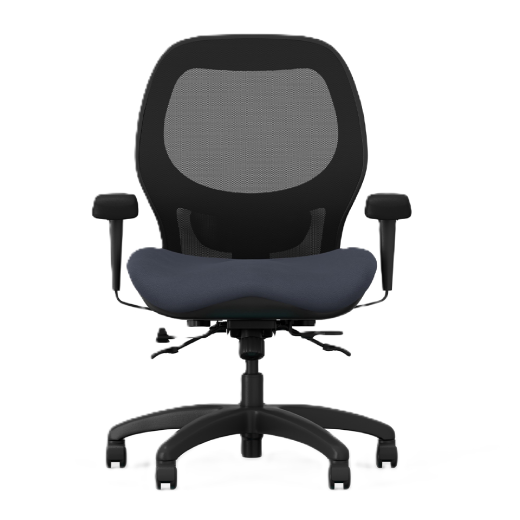
Chapter 2: Mesh Engineering Fundamentals: Beyond Surface-Level Breathability Claims
The proliferation of mesh-backed office chairs has created widespread misunderstanding about what constitutes genuine ergonomic mesh technology versus marketing-driven aesthetics. Authentic ergonomic mesh office chair design involves sophisticated material science where tensile properties, weave density, and elastic recovery rates determine functional performance. Premium mesh materials employ multi-directional elasticity—stretching vertically to accommodate spinal movement while maintaining horizontal stability to prevent lateral slumping. This engineered flexibility allows the material to conform dynamically to the user's back contour without developing permanent deformation, a critical distinction from cheaper alternatives that lose supportive tension after weeks of use.
Thermoregulation represents another dimension where mesh engineering delivers measurable physiological benefits. During prolonged sitting sessions, heat accumulation at the body-chair interface can compromise circulation, particularly in the lumbar and thoracic regions. High performance mesh structures incorporate microscopic air channels that facilitate convective cooling, reducing skin temperature and supporting healthier capillary flow. The full mesh back design philosophy—extending breathable material across the entire backrest rather than limiting it to lumbar zones—creates comprehensive thermal management that prevents moisture buildup and enhances comfort during concentrated work sessions.
Industry innovators have advanced this approach by developing integrated mesh systems where the seat and backrest function as a unified supportive structure. Implementations like the China ergonomic full mesh back office chair model exemplify how material continuity between seating surfaces can distribute pressure more evenly while maintaining consistent breathability across all contact points—a design consideration particularly valuable for users in humid climates or those prone to temperature sensitivity.
Chapter 3: Mechanism Intelligence: How Synchronous Systems Transform Static Sitting into Dynamic Support
Most office chair purchasers focus on visible features while overlooking the hidden mechanical architecture that fundamentally determines long-duration comfort. The mechanism beneath the seat cushion functions as the chair's central nervous system, governing how components interact during movement. Basic tilt mechanisms operate around a single pivot point, forcing users to choose between reclined relaxation and upright productivity. In contrast, synchronous mechanisms employ dual-pivot engineering where seat angle and backrest angle adjust proportionally but independently, preserving healthy hip flexion angles critical for circulation maintenance during extended sitting periods.
Seat depth adjustment represents another underappreciated feature with profound ergonomic implications. Individuals with shorter femurs require reduced seat depth to prevent pressure behind the knees—a compression point that can restrict blood flow and induce numbness. Conversely, taller users need extended seat depth to ensure full thigh support. Similarly, the swivel computer chair functionality serves critical ergonomic purposes when engineered correctly. A smooth 360-degree rotation mechanism reduces torso twisting forces by allowing users to access peripheral workspaces through chair movement rather than spinal rotation, decreasing shear forces on intervertebral discs during frequent reaching motions.
These mechanical considerations become especially relevant when distinguishing task seating from waiting room chairs. While both categories benefit from ergonomic principles, waiting room chairs prioritize durability and universal fit for intermittent use rather than the personalized adjustability required for eight-hour daily occupation. Understanding these contextual differences prevents misapplication of seating solutions—a common error where facilities install waiting room chairs in permanent workstations, inadvertently creating cumulative strain.
Chapter 4: Contextual Ergonomics: Matching Seating Solutions to Usage Duration and Environmental Factors
Selecting appropriate seating requires moving beyond generic labels to analyze specific usage patterns and environmental contexts. An ergonomic desk chair designed for continuous occupation demands fundamentally different engineering priorities than seating intended for intermittent use. Full-time work chairs require multi-axis adjustability systems allowing precise calibration to individual anthropometry—seat height ranges spanning diverse statures, independently adjustable armrests that prevent shoulder elevation during typing, and lumbar systems with vertical travel exceeding three inches to match varying spinal contours. These features represent non-negotiable requirements for chairs supporting prolonged static postures where minor misalignments compound into significant discomfort.
Environmental factors further refine selection criteria. In warm or humid climates, the breathable properties of an ergonomic mesh office chair become physiologically necessary—preventing moisture accumulation that compromises skin integrity during extended contact. Conversely, in temperature-controlled environments, users might prioritize different material properties without sacrificing core ergonomic functions. The critical insight lies in recognizing that “ergonomic” isn't a binary classification but a spectrum of design responses to specific human-environment interactions.
This contextual understanding explains why premium manufacturers invest in modular adjustment systems rather than fixed configurations. A chair serving multiple users across shifts requires tool-free adjustments accessible without technical expertise. For single-user applications, more precise micro-adjustments become valuable, allowing fine-tuning that matches the chair's behavior to subtle personal preferences in recline resistance or forward tilt activation. These nuanced distinctions separate truly adaptive seating from superficially adjustable alternatives.
Frequently Asked Questions
What distinguishes an ergonomic desk chair from standard office seating?
True ergonomic desk chairs incorporate scientifically validated adjustment ranges matching human anthropometric diversity, with mechanisms engineered to preserve natural spinal alignment during movement rather than merely offering static support. They feature independently adjustable components—seat height, depth, lumbar position, and armrest geometry—that allow precise calibration to individual body dimensions.
Why do ergonomic mesh office chairs perform better for long sessions than padded alternatives?
Mesh materials provide dynamic conformability that distributes pressure evenly while maintaining consistent breathability across the entire backrest surface. This dual functionality prevents heat accumulation that compromises circulation during extended sitting, while the elastic properties support natural spinal movement without developing permanent compression set common in foam padding.
Are swivel computer chairs inherently more ergonomic than fixed-base seating?
The swivel function itself enhances ergonomics when properly implemented with smooth rotation mechanics and stable five-point bases. It reduces harmful twisting motions by allowing users to reposition through chair movement rather than spinal rotation, decreasing shear forces on intervertebral discs during frequent reaching activities across the workstation.
Can waiting room chairs substitute for ergonomic task seating in home offices?
Waiting room chairs prioritize durability and universal fit for intermittent use rather than the personalized adjustability required for prolonged occupation. They typically lack critical features like seat depth adjustment, dynamic lumbar systems, and synchronized tilt mechanisms necessary for maintaining healthy posture during eight-hour work sessions, making them unsuitable substitutes for dedicated ergonomic task chairs despite superficial similarities.
What Are The Key Features Of An Ergonomic Office Chair?
Top-Rated Office Chairs For Lower Back Pain Relief
Latest Blog