
NEWS
Data is empty
Comparison of Mesh VS Leather Office Chairs For Comfort
When selecting ergonomic chair for home office or extended work sessions, the choice between mesh and leather transcends mere aesthetics—it engages fundamental physiological processes governing thermal regulation, postural support, and long term tissue health. While leather chairs project executive sophistication and initial plushness, mesh constructions operate on entirely different biomechanical principles, prioritizing dynamic conformity over static cushioning. This material dichotomy creates divergent comfort trajectories: leather often delivers immediate tactile satisfaction that may degrade into heat retention and static pressure points during prolonged use, whereas mesh typically requires brief acclimatization before revealing its capacity for sustained thermal neutrality and adaptive spinal alignment.
Understanding these underlying mechanisms transforms chair selection from a style decision into a strategic investment in daily physiological well-being—particularly critical for remote workers investing in an ergonomic chair for home office environments where seating quality directly impacts productivity and physical resilience.
Thermal Dynamics and Material Science—Why Breathability Determines Long-Hour Viability
The human body continuously dissipates heat through convection and evaporation, processes critically disrupted when seated against non-porous surfaces. Leather's molecular structure—whether genuine or synthetic—creates a vapor barrier that traps metabolic heat against the skin's surface, elevating local temperature by two to four degrees Celsius within thirty minutes of continuous contact. This thermal accumulation triggers compensatory sweating, which leather's hydrophobic properties cannot effectively wick away, creating a microclimate of humidity that accelerates muscular fatigue through disrupted thermoregulation.
Mesh materials counter this through engineered porosity: high-tension woven polymers create microscopic channels allowing bidirectional airflow, facilitating continuous convective cooling that maintains skin temperature within one degree Celsius of ambient conditions even during extended sessions. This isn't merely about comfort preference—elevated tissue temperature directly correlates with accelerated disc dehydration and reduced paraspinal muscle endurance, making thermal management a legitimate ergonomic consideration rather than a luxury feature. The distinction proves especially consequential for professionals in warm climates or non-air-conditioned home offices, where material breathability transitions from convenience to physiological necessity.
Support Architecture—How Material Properties Dictate Lumbar Engagement Strategies
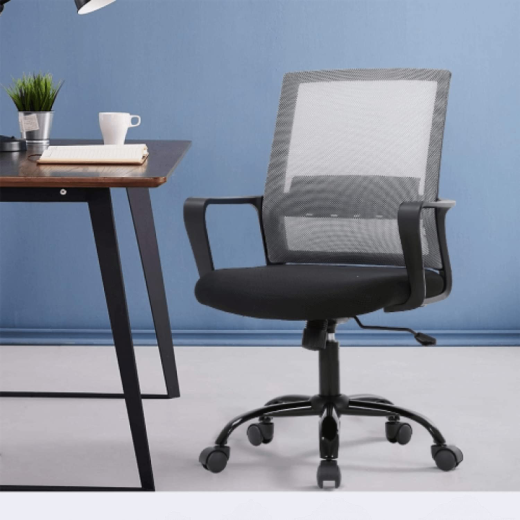
Leather office chairs typically deliver lumbar support through layered foam padding sculpted into fixed contours beneath the upholstery—a passive system requiring precise anatomical alignment to function effectively. When users shift posture, such as leaning forward to type or reclining during calls, these static contours lose contact with the lumbar curve, creating support gaps precisely when spinal loading increases. Mesh chairs employ fundamentally different mechanics: the woven structure itself becomes the support medium, with tension calibrated to provide graduated resistance that increases proportionally with applied force. This dynamic response allows the material to maintain continuous contact with the lumbar region through postural transitions, distributing compressive loads across the entire backrest surface rather than concentrating pressure at isolated contact points.
Advanced implementations feature zoned tension engineering—strategic variations in mesh weave density that create firmer resistance precisely at the L3-L5 region while maintaining flexibility in thoracic zones. This material-integrated support eliminates the mechanical complexity of external lumbar paddles that often slip out of position or create pressure points. Manufacturers like FSGROWING have refined this approach in their full mesh constructions, engineering tension profiles that preserve lumbar lordosis without requiring manual adjustment—a significant advantage for users who frequently change positions throughout the workday yet lack time for constant ergonomic recalibration.
Durability Realities and Lifecycle Economics Beyond Discount Office Chairs
Initial purchase price frequently misrepresents true seating value when material degradation patterns remain unexamined. Discount office chairs employing bonded leather or low-grade synthetics often exhibit surface cracking within eighteen to twenty-four months, particularly at flexion points like seat edges and backrest junctions. These fractures compromise both aesthetics and structural integrity, as underlying foam becomes exposed to environmental degradation. Genuine top-grain leather withstands longer but demands rigorous maintenance—quarterly conditioning to prevent desiccation-induced cracking, UV protection to avoid fading, and meticulous cleaning to prevent pore clogging that accelerates material stiffening.
Mesh materials present contrasting durability profiles: high-tenacity polymer weaves resist UV degradation, moisture absorption, and surface abrasion far more effectively than organic materials. However, mesh longevity hinges critically on frame integration quality—poorly tensioned mesh stretches permanently under load, while inadequate attachment points lead to edge delamination.
The most resilient implementations anchor mesh to aircraft-grade aluminum frames with mechanical fasteners rather than adhesives, ensuring tension integrity survives fifty thousand or more compression cycles. This engineering distinction explains why premium mesh desk chair options maintain support geometry for seven to ten years while budget alternatives sag noticeably within two years—transforming the initial price differential into long-term value reversal. Home office users particularly benefit from this durability calculus, as residential seating typically receives less rigorous daily use than corporate environments yet must maintain performance across unpredictable usage patterns.
Contextual Selection Framework—Matching Material Properties to Environmental and Behavioral Realities
Optimal material selection emerges not from universal superiority claims but from aligning chair properties with specific usage contexts. Mesh constructions prove decisively advantageous for users in warm or humid climates, individuals prone to heat sensitivity, professionals conducting extended focused work sessions exceeding four consecutive hours, and home office environments lacking climate control. Their breathability and dynamic support directly address physiological stressors inherent in these scenarios. Leather alternatives find legitimate application in temperature-controlled executive settings where brief intermittent sitting predominates, users prioritizing acoustic properties since mesh can produce subtle tension sounds during movement, or environments where aesthetic formality outweighs ergonomic optimization. Crucially, hybrid approaches now bridge this divide: some manufacturers integrate perforated leather panels at high-sweat zones while retaining solid upholstery elsewhere, though these compromise solutions rarely match full-mesh breathability.
For remote workers establishing dedicated home offices, the mesh desk chair category warrants particular consideration—not merely for thermal advantages but for its compatibility with variable daily routines where users transition between focused work, video calls, and casual browsing without constant posture recalibration. When evaluating options beyond discount office chairs, prioritize manufacturers demonstrating material transparency—specific polymer specifications for mesh tension ratings, frame metallurgy details, and warranty coverage explicitly addressing support degradation rather than merely cosmetic wear. Companies like FSGROWING exemplify this transparency through detailed engineering documentation of their full mesh constructions, enabling informed selection beyond marketing claims.
Frequently Asked Questions
What makes a mesh desk chair superior for an ergonomic chair for home office setup compared to leather alternatives?
Mesh desk chairs provide continuous airflow preventing heat accumulation during variable-length work sessions common in home environments, while their dynamic tension adapts to frequent posture changes without manual adjustment—critical when users lack dedicated ergonomic training or time for constant recalibration.
Do discount office chairs with mesh backs deliver comparable benefits to premium models?
Budget mesh chairs often use lower-tension weaves that stretch permanently within months, compromising lumbar support geometry. Premium constructions employ calibrated tension profiles anchored to reinforced frames, maintaining support integrity through years of use—a distinction justifying price differentials for daily users.
How does FSGROWING approach mesh chair engineering differently from conventional manufacturers?
FSGROWING focuses on full-mesh integration where the entire backrest functions as a unified support system with zoned tension engineering, eliminating separate lumbar mechanisms that can slip or create pressure points while maintaining breathability across the complete spinal contact surface.
Can leather office chairs ever be appropriate for hot climate home offices?
Only with significant environmental controls—consistent air conditioning below twenty-two degrees Celsius, low humidity environments, and usage patterns involving frequent standing breaks. Without these conditions, leather's heat retention properties typically overwhelm its aesthetic advantages for extended sitting sessions.
What maintenance practices extend mesh chair longevity versus leather alternatives?
Mesh requires minimal upkeep—occasional vacuuming to prevent dust accumulation in weave channels. Leather demands quarterly conditioning, UV protection, and pH-neutral cleaning to prevent cracking. This maintenance disparity significantly impacts long-term ownership experience, particularly for busy remote workers.
Complete Guide to Best Recliner Chair Mechanism
How To Properly Adjust An Office Chair For Optimal Comfort?
Latest Blog