
NEWS
Different Types of Casters
Casters — those humble, often overlooked components beneath chairs, carts, and industrial equipment — are far more complex than they appear. The right caster doesn't just roll; it supports weight, absorbs shock, resists wear, protects flooring, and even contributes to ergonomic health. With countless configurations available, selecting the appropriate type isn't a matter of convenience — it's an engineering decision.
PU Casting Wheels: The Silent Workhorses of Modern Mobility
Polyurethane (PU) is the gold standard for tread material in environments demanding quiet operation, floor protection, and resilience. PU casting wheels combine the structural strength of metal or reinforced nylon cores with the cushioning and non-marking properties of polyurethane tread — making them ideal for offices, labs, retail, and healthcare.
Why PU?
Floor Friendly: Unlike hard rubber or metal, PU doesn't scratch hardwood, laminate, or polished concrete.
Noise Reduction: PU absorbs vibration and dampens sound — critical in libraries, call centers, or executive suites.
Load Resilience: High-density PU maintains shape under pressure, resisting flat spotting even after years of static load.
Chemical Resistance: PU holds up against common cleaning agents, oils, and solvents — unlike cheaper PVC or TPR alternatives.
FSGROWING's PU casting wheels, for instance, utilize precision-molded treads bonded directly to steel or aluminum cores — not glued or mechanically pressed — ensuring zero delamination under stress. This manufacturing nuance is invisible to the end user but critical for longevity.
Applications range from medical equipment carts to high-end office seating — anywhere quiet, smooth, and reliable rolling is non-negotiable.
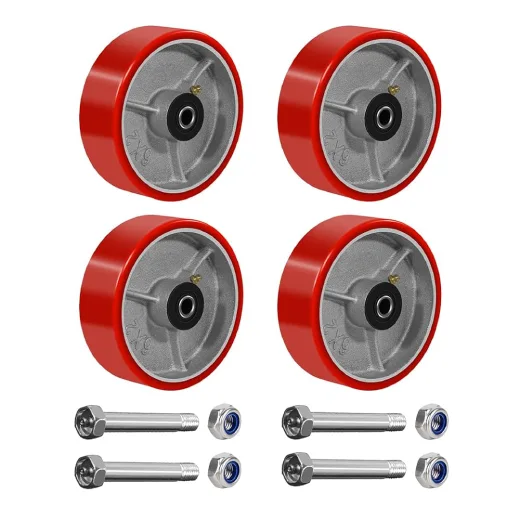
Heavy Duty PU Caster Wheels: Engineering for Extreme Loads and Continuous Use
Not all PU casters are created equal. When you search for ‘heavy duty PU caster wheels,’ you're entering the realm of industrial-grade mobility — where failure isn't an option.
These casters are engineered for:
Load capacities exceeding 300 lbs per wheel
24/7 operation in warehouses, factories, or hospital ICUs
Resistance to impact, abrasion, and deformation
Compatibility with rough, uneven, or debris-laden surfaces
The ‘heavy duty’ designation isn't marketing fluff. It refers to:
Reinforced Core Construction: Often forged steel or ductile iron, not stamped sheet metal.
Precision Bearings: Tapered roller or double-row ball bearings that handle radial and axial loads simultaneously.
Thicker Tread Profiles: 15–25mm of high-rebound PU, often with chamfered edges to reduce edge wear.
Sealed Swivel Joints: Grease-retaining seals that prevent grit ingress — extending maintenance intervals.
FSGROWING's heavy-duty line, for example, includes models with kingpinless swivel mechanisms — eliminating a common point of failure in traditional casters. These are deployed under tool cribs, aircraft maintenance stands, and modular cleanroom furniture — environments where downtime costs thousands per minute.
Specifying heavy duty PU caster wheels isn't about over-engineering. It's about matching mechanical properties to operational reality.
Swivel Chair Casters vs. Rigid Casters: The Physics of Directional Control
One of the most fundamental distinctions in caster taxonomy is swivel versus rigid.
Rigid casters move only in a straight line — forward and backward. Ideal for controlled-path applications like hospital stretchers or assembly line dollies.
Swivel casters rotate 360 degrees, enabling multidirectional movement. Essential for office chairs, mobile workstations, and diagnostic carts.
When discussing swivel chair casters, we're typically referring to light-to-medium duty configurations designed for frequent directional changes and ergonomic repositioning. Key engineering considerations include:
Swivel Offset: The distance between the wheel center and the swivel axis. Greater offset = easier turning, but less stability under load.
Bearing Type: Delrin or steel ball bearings? The former offers quietness; the latter, durability.
Return Torque: How easily the caster ‘snaps back to straight ahead after turning — critical for chair stability.
FSGROWING's chair swivel casters integrate dual-bearing swivel heads with low-friction seals — reducing rotational resistance while maintaining structural integrity. This is especially valuable in office chair swivel casters, where users make hundreds of micro-adjustments daily. A poorly engineered swivel mechanism leads to binding, uneven wear, and premature failure.
Pro tip: For chairs used on high-pile carpet, opt for larger diameter wheels (≥3”) to reduce rolling resistance. On hard floors, smaller diameters (2”–2.5”) with softer PU offer better control.
Office Chair Swivel Casters: Where Ergonomics Meet Material Science
The office chair swivel casters beneath your desk do more than roll — they influence posture, productivity, and even long-term musculoskeletal health.
Consider:
Rolling Resistance: Too high, and users strain to move — leading to static sitting. Too low, and chairs drift unintentionally.
Stability vs. Maneuverability: A chair that spins too freely feels unstable. One that resists turning causes frustration.
Weight Distribution: Most office chairs use five casters. Each must handle 20–25% of total load — including occupant, chair, and accessories.
FSGROWING's approach to office chair swivel casters involves:
Dual-Density PU Treads: Softer outer layer for grip and quietness; firmer inner core for load support.
Threaded Stem or Grip Ring Compatibility: Ensuring fit with global chair base standards (M8, M10, 7/16”, etc.)
ESD and Non-Marking Options: For electronics labs or luxury flooring environments.
Interestingly, many premium office chairs still ship with basic nylon casters — a cost-saving measure that backfires in real-world use. Replacing them with engineered PU swivel casters is one of the highest-ROI upgrades a company or individual can make.
Choosing the Right Caster Type: A Framework for Decision-Making
With so many variables — material, load, environment, floor type, stem style, brake requirement — how do you choose?
Use this mental checklist:
Load per Wheel = (Total Weight + Safety Factor 1.5) ÷ Number of Casters
Floor Surface → Dictates tread material (PU for hard floors, rubber for carpet, conductive for ESD zones)
Mobility Pattern → Swivel for multidirectional, rigid for linear, or combination (2 swivel + 2 rigid) for controlled steering
Environmental Stressors → Moisture? Chemicals? Temperature extremes? → Dictates core material (stainless, zinc, polypropylene)
Maintenance Tolerance → Sealed bearings and non-grease swivels for low-maintenance settings
Manufacturers like FSGROWING don't just sell casters — they publish load charts, CAD drawings, and compatibility matrices. This transparency allows engineers and procurement teams to make evidence-based selections — not guesswork.
Casters Are Infrastructure
The next time you glide your chair across the floor or push a cart down a hospital corridor, remember: that motion is enabled by decades of materials research, mechanical innovation, and precision manufacturing.
Whether you're specifying PU casting wheels for a new furniture line, sourcing heavy duty PU caster wheels for industrial logistics, or replacing worn out office chair swivel casters, understanding the ‘why’ behind each design choice transforms you from a buyer into a systems thinker.
Elevate your workspace with FSGROWING's high quality pu casting wheels — engineered for durability, comfort, and modern style. Designed to provide superior stability and long lasting performance, our premium quality office chair swivel casters are the ideal choice for today's professional offices.
How to Remove a Gas Lift from an Office Chair?
Are PU Wheels Better Than Rubber?
Latest Blog