
NEWS
Data is empty
How to Select Plywood Chair Seats and Backs for Furniture Manufacturing
Plywood chair seats and backs are widely used in office chairs, dining chairs, school furniture, and commercial seating because they combine structural strength, dimensional stability, and design flexibility. However, selecting the right plywood components involves more than comparing thickness or appearance. Veneer quality, layer configuration, bending radius, adhesive performance, mounting structure, and surface treatment all influence the final product's durability and comfort.
1. What Makes Plywood Suitable for Chair Seats and Backs?
1.1 Why Is Plywood Stronger and More Stable Than Solid Wood in Many Chair Applications?
Plywood is manufactured by bonding multiple thin wood veneer layers together, generally with adjacent layers arranged at approximately 90-degree grain orientations. This cross-laminated construction helps distribute loads, reduce directional movement, and improve dimensional stability.
Unlike solid wood, which has different strength characteristics along and across the grain, plywood provides more balanced mechanical properties. This makes it suitable for chair seats and backrests that experience repeated loading, bending forces, and changes in environmental humidity.
Three properties deserve particular attention:
- Load-bearing capacity: The number, thickness, and quality of veneer layers influence bending strength and stiffness.
- Dimensional stability: Cross-grain construction helps limit expansion, contraction, and warping.
- Manufacturing flexibility: Veneer layers can be bonded in specially designed molds to produce curved surfaces.
When evaluating a chair plywood seat, manufacturers should consider the complete laminate structure rather than relying exclusively on nominal thickness.
1.2 What Is the Difference Between Flat Plywood and Bent Plywood Chair Components?
Flat plywood panels are suitable for conventional seating structures, especially when upholstery or additional support materials are required. Bent plywood, however, is manufactured into a three-dimensional shape to provide integrated structural support and ergonomic contours.
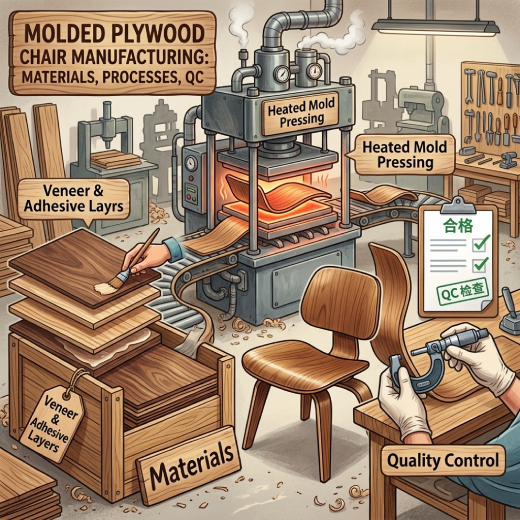
The production of bent plywood seat chair parts generally involves veneer preparation, adhesive application, cross-layer stacking, mold pressing, curing, trimming, drilling, and finishing.
Heat and pressure allow the adhesive to bond the veneer layers while the mold establishes the required curvature. Unlike bending a finished flat panel, molded plywood develops its shape during lamination.
This approach is particularly useful for furniture designs requiring curved seat pans, backrests, and integrated shells.
2. How Should Manufacturers Evaluate Plywood Materials and Structural Specifications?
2.1 Which Wood Species, Veneer Layers, and Thickness Should Buyers Choose?
Different wood species offer different combinations of density, stiffness, surface appearance, and processing characteristics. Birch, beech, maple, and poplar are commonly considered in plywood furniture applications.
| Selection factor | Key characteristics | Manufacturing considerations |
| Birch plywood | Good strength and relatively uniform structure | Suitable for demanding structural applications |
| Beech plywood | Dense, durable, and attractive grain | Suitable for molded furniture components |
| Maple plywood | Hard surface and consistent appearance | Suitable for exposed chair seats and backs |
| Poplar plywood | Lightweight and relatively economical | Requires careful structural evaluation |
| 5-ply construction | Multiple bonded veneer layers | Suitable for various conventional seating designs |
| 7-ply or thicker construction | More laminated layers | Can provide greater stiffness depending on veneer specifications |
There is no universal thickness for every chair. For example, a commercial plywood chair specification may use approximately 9.5 mm plywood for a seat, while other designs require thicker panels or different layer configurations.
The actual requirement depends on unsupported span, seat geometry, mounting position, user load, and applicable furniture performance standards.
2.2 How Do Curvature and Ergonomic Design Affect Seat and Backrest Selection?
Ergonomics is not determined by cushioning alone. The geometry of the plywood substrate influences how the user's weight is distributed and how the backrest supports the body.
For seats, important design features include:
- Seat depth: Must accommodate the intended user population without excessive pressure behind the knees.
- Waterfall front edge: A downward-curved front edge can help reduce pressure on the underside of the thighs.
- Seat contour: A shallow concave profile can improve seating stability.
- Backrest curvature: A properly designed curve supports the back while maintaining an appropriate sitting posture.
2.3 Which Quality Problems Should Buyers Check Before Mass Production?
Several manufacturing defects can compromise the performance of plywood seating components.
Delamination: Insufficient adhesive coverage, incorrect pressing conditions, or poor veneer preparation may cause layers to separate.
Cracking and springback: Inappropriate veneer moisture content, excessive bending stress, or inadequate curing can cause deformation after demolding.
Surface defects: Uneven sanding, veneer defects, and inconsistent finishing can affect appearance and coating adhesion.
Mounting failures: Poorly positioned holes, insufficient edge distance, or unsuitable fasteners may cause local splitting and loose connections.
3. How Can Manufacturers Ensure Compatibility, Durability, and Cost Efficiency?
3.1 What Should Buyers Consider When Ordering Plywood Chair Seat Replacement Components?
Replacement compatibility is a common challenge for furniture distributors, repair businesses, and manufacturers managing multiple chair models.
A replacement component that looks identical may still fail during installation because of differences in mounting dimensions or structural geometry.
When sourcing plywood chair seat replacement products, buyers should confirm:
1. Overall width, depth, and thickness.
2. Distance between mounting holes and hole diameters.
3. Hole positions relative to the seat centerline.
4. Underside curvature and mechanism clearance.
5. Fastener type, thread specification, and embedment depth.
6. Surface finish and compatibility with upholstery materials.
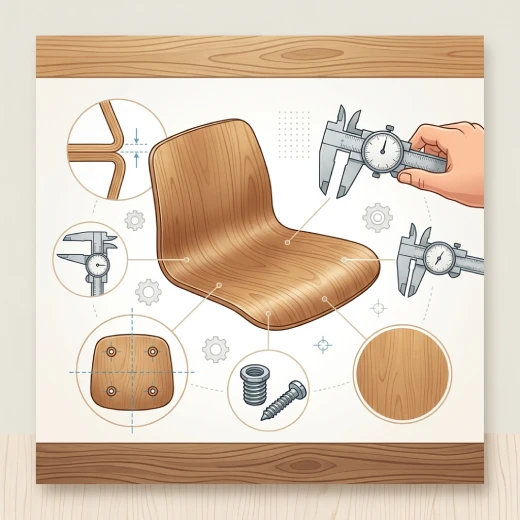
For bent plywood seat chair parts, the underside profile deserves particular attention. A curved bottom surface may prevent a chair mechanism from sitting flush against the panel.
A useful procurement practice is to provide suppliers with technical drawings, physical samples, mounting-hole diagrams, and photographs of the original component.
3.2 How Do Manufacturing Processes Influence Long-Term Performance?
The quality of plywood depends on the interaction between raw materials and production parameters.
Veneer moisture content affects bonding and dimensional stability. Adhesive viscosity and application uniformity influence the integrity of glue lines. Pressing temperature, pressure, and curing time determine whether the adhesive develops sufficient bonding strength.
After pressing, components typically undergo stabilization, trimming, edge machining, drilling, sanding, and finishing.
Manufacturers should also inspect finished chair plywood seat components for thickness variation, warping, surface defects, and dimensional consistency.
Cost optimization should not simply mean reducing veneer layers or selecting cheaper adhesives. A better approach is to match material specifications to actual loading conditions and production requirements.
For example, using unnecessarily thick plywood can increase material consumption and shipping weight, while insufficient thickness may increase deformation and warranty claims.
4. Industry FAQs: What Should Buyers Know Before Purchasing Plywood Chair Components?
Q1: Can a plywood chair seat replacement component fit different chair models?
Not necessarily. Different chair models may use different seat dimensions, mounting-hole patterns, thicknesses, and mechanism interfaces. Buyers should verify technical drawings and physical samples before ordering. A universal replacement specification should not be assumed.
Q2: Is thicker plywood always better for commercial seating?
No. Thickness alone does not determine structural performance. Veneer species, layer arrangement, adhesive bonding, seat geometry, and unsupported span also matter. A properly engineered thinner component may outperform a poorly manufactured thicker panel.
Q3: Why do bent plywood seat chair parts sometimes develop cracks or delamination?
Common causes include inconsistent veneer moisture, insufficient adhesive coverage, excessive bending stress, unsuitable pressing parameters, and inadequate curing. These problems should be investigated through process inspection rather than addressed only by increasing material thickness.
Q4: Should buyers choose pre-drilled or unfinished plywood chair components?
Pre-drilled components can reduce assembly time and improve production efficiency when mounting specifications are standardized. However, unfinished components may offer greater flexibility for customized furniture projects. The decision depends on production volume, customization requirements, and the buyer's machining capabilities.
Q5: What documents should manufacturers request from plywood component suppliers?
Important documents include dimensional drawings, material specifications, quality inspection reports, adhesive compliance information, and relevant mechanical test results. For large-volume procurement, buyers should also establish approved samples, inspection criteria, acceptable tolerances, and batch traceability requirements.
If you are developing a new chair collection or optimizing an existing furniture supply chain, contact FSGROWING to discuss your component specifications, product drawings, and manufacturing requirements.
Related blog
Latest Blog