
NEWS
Data is empty
Plywood Chair Manufacturing
Plywood chair manufacturing combines wood-material engineering, precision forming, structural design, and furniture assembly. From selecting suitable veneers to producing curved seat shells and installing hardware, every production stage affects the finished chair's strength, appearance, comfort, and service life.
1. How Does Plywood Chair Manufacturing Start with Material Preparation?
1.1 What Types of Wood Veneers Are Suitable for Shape Plywood Chair Production?
Material selection determines the mechanical properties, appearance, and processing performance of a shape plywood chair.
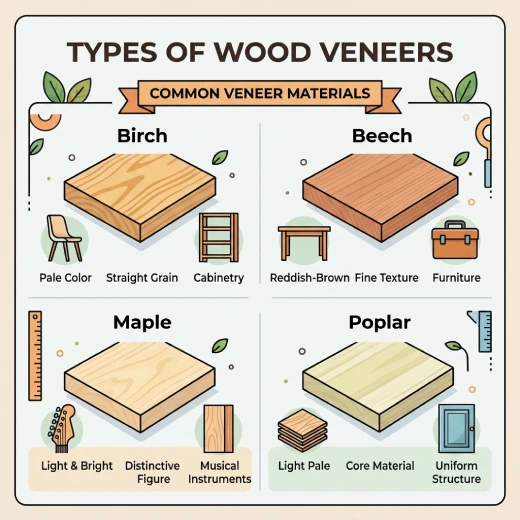
Common veneer materials include birch, beech, maple, and poplar. Each offers different characteristics:
Birch: Relatively high strength, uniform structure, and good machining performance.
Beech: Dense structure and attractive appearance, suitable for furniture components requiring durability.
Maple: Hard surface and consistent grain, often selected for visible furniture surfaces.
Poplar: Lightweight and economical, suitable for applications where weight and material cost are important.
1.2 Why Are Veneer Drying and Grading Critical Before Lamination?
Veneer preparation is more than cutting wood into thin sheets. Moisture consistency directly affects adhesive bonding, dimensional stability, and the risk of defects during pressing.
Excessive moisture can interfere with adhesive curing and generate internal steam pressure during hot pressing. Overly dry or damaged veneers may become brittle and develop cracks during forming.
Before lamination, manufacturers should control:
1. Veneer thickness and dimensional consistency.
2. Moisture content appropriate to the adhesive and pressing process.
3. Surface cleanliness and the absence of contaminants.
4. Knots, splits, and other structural defects.
5. Grain direction and veneer arrangement.
For a diy plywood chair design intended for repeat production, establishing a standardized material specification is particularly important. Without consistent incoming materials, even a well-designed mold cannot guarantee uniform finished components.
1.3 Which Adhesives and Layer Configurations Improve Chair Strength?
Plywood strength depends on the interaction between veneer species, adhesive performance, layer count, and grain orientation.
Adjacent veneer layers are generally arranged with alternating grain directions. This cross-laminated structure improves dimensional stability and distributes loads across multiple directions.
Phenol-formaldehyde, urea-formaldehyde, and other engineered adhesive systems have different bonding properties and service-condition suitability. The selection should consider moisture exposure, curing requirements, emission regulations, and the intended furniture application.
2. How Do Manufacturers Shape Plywood into Ergonomic Chair Structures?
2.1 How to Make a Bent Plywood Chair Using Mold Pressing Technology?
Bent plywood manufacturing allows designers to create curved seats, backrests, armrests, and integrated chair shells without relying on multiple solid-wood components.
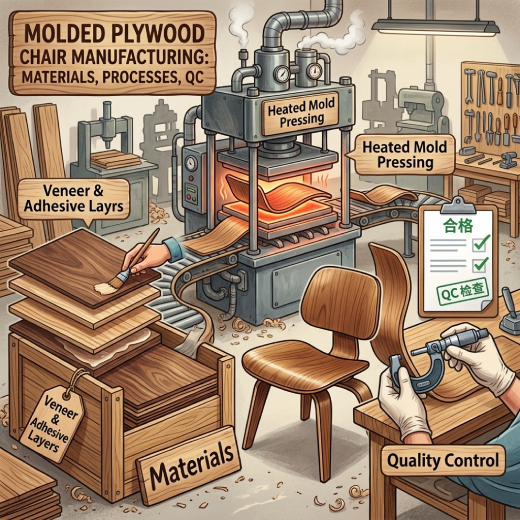
For commercial production, the typical process includes:
Step 1: Prepare and cut veneers. Veneers are trimmed to the required dimensions and inspected for thickness, moisture, and defects.
Step 2: Apply adhesive. A controlled adhesive layer is applied to the specified veneer surfaces. Glue spread and assembly time must remain within the adhesive manufacturer's recommended process window.
Step 3: Arrange veneer layers. The veneers are stacked according to the specified ply schedule, with grain directions alternating between adjacent layers.
Step 4: Position the lay-up in the mold. The prepared veneer stack is placed inside a shaped mold. Mold geometry determines the final curvature and dimensional profile.
Step 5: Apply heat and pressure. Hydraulic or specialized molding equipment consolidates the layers and cures the adhesive. Temperature, pressure, and pressing duration must be matched to the adhesive, veneer thickness, and mold design.
Step 6: Cool, stabilize, and demold. The formed component is allowed to stabilize before removal. This stage helps reduce deformation and springback.
Step 7: Trim and finish. Excess material is removed, edges are machined, and surfaces are sanded or coated.
2.2 How Do Mold Design and Springback Affect Bent Plywood Quality?
Springback refers to the partial recovery of a bent shape plywood component after pressure is released. It can result from residual stresses within the veneer layers, adhesive curing conditions, material characteristics, and mold geometry.
Several controls help reduce this problem:
Develop molds according to the actual veneer and adhesive specifications.
Test different pressing conditions before mass production.
Maintain consistent veneer moisture and layer thickness.
Evaluate the finished curvature after stabilization rather than immediately after demolding.
Record mold dimensions and inspect components against approved samples.
| Component type | Manufacturing method | Main advantages | Typical applications |
| Flat shape plywood panel | Cutting and machining | Simple processing and economical production | Basic chair seats and structural panels |
| Bent shape plywood component | Veneer lamination and mold pressing | Integrated curves and ergonomic shaping | Curved seats and backrests |
| Molded shape plywood shell | Custom mold forming and precision finishing | Complex three-dimensional geometry | Dining chairs, lounge chairs, and integrated seating |
3. How Are Shape Plywood Chair Components Machined and Assembled?
3.1 Why Are CNC Cutting, Edge Finishing, and Drilling Important?
After forming, shape plywood components require accurate machining before assembly.
CNC routing and precision drilling are commonly used to produce consistent outlines, mounting holes, slots, and connection points. These operations are particularly important when the chair combines shape plywood structures with metal mechanisms or plastic components.
Several manufacturing details deserve attention:
Hole positioning: Incorrect mounting-hole locations can prevent components from fitting the chair frame.
Edge quality: Poor cutting can cause veneer breakout, splintering, or exposed core layers.
Thickness tolerance: Inconsistent thickness affects fastening and assembly alignment.
Surface finishing: Sanding and coating should provide consistent appearance without unnecessarily removing the outer veneer.
3.2 How Should Plywood Seats and Backs Be Connected to Chair Hardware?
The connection between shape plywood and hardware is a major source of long-term furniture failures.
Common fastening methods include screws, threaded inserts, bolts, brackets, and specialized mounting plates.
During final assembly, manufacturers should verify:
1. Seat and backrest alignment.
2. Fastener engagement and tightening torque.
3. Contact between mounting plates and shape plywood surfaces.
4. Stability under expected loading conditions.
5. Absence of abnormal movement, noise, or sharp edges.
A properly shaped plywood component still requires a carefully engineered connection system to function as a complete chair.
3.3 How Do Different Chair Components Work Together in Final Assembly?
Modern office chairs frequently combine plywood or molded seat structures with plastic and metal components.
For example, a chair may include a plywood seat, molded backrest, metal mechanism plate, gas lift cylinder, chair base, casters, and adjustable armrests.
Each component has its own manufacturing tolerances. However, final product quality depends on their compatibility.
4. What Quality Control Standards Should Plywood Chair Manufacturers Follow?
4.1 How Can Manufacturers Prevent Cracking, Delamination, and Structural Failure?
Quality problems in shape plywood chair production often originate from earlier manufacturing stages rather than final assembly.
Common defects include:
Delamination: Caused by inadequate adhesive coverage, unsuitable pressing conditions, or poor veneer preparation.
Cracking: Often associated with excessive bending stress, brittle veneers, or unsuitable forming radii.
Warping: May result from uneven moisture distribution, asymmetrical construction, or residual internal stress.
Surface defects: Include veneer bubbles, sanding marks, scratches, and uneven coatings.
Assembly failures: Can result from incorrect hole positions, insufficient fastening strength, and incompatible hardware.
4.2 Which Tests Should Buyers Request Before Approving Mass Production?
For commercial furniture procurement, visual inspection alone is insufficient.
Buyers should consider the following testing requirements:
- Static load testing to evaluate seat and backrest strength.
- Durability testing to simulate repeated sitting and leaning.
- Joint and fastening tests to identify connection failures.
- Dimensional inspections to verify mounting compatibility.
- Environmental conditioning to evaluate dimensional stability.
- Surface and coating inspections to assess finish consistency.
5. FAQ: What Should Furniture Buyers Know About Plywood Chair Manufacturing?
Q1: How thick should shape plywood be for manufacturing a chair?
There is no universal thickness. Seat dimensions, veneer species, ply configuration, unsupported span, and loading requirements all influence the specification. Manufacturers should determine thickness through structural calculations and prototype testing rather than copying a general industry measurement.
Q2: Why do bent plywood chairs sometimes lose their original shape?
Springback, uneven veneer moisture, inadequate bonding, and inconsistent pressing conditions are common causes. Mold compensation and post-press dimensional inspection are essential for controlling curvature.
Q3: Is DIY plywood chair design suitable for mass production?
A diy plywood chair design can provide a useful starting point for product development. However, commercial manufacturing requires additional engineering, including material standardization, mold repeatability, fastening design, production tolerances, and durability testing.
Q4: What is the most difficult stage when learning how to make a bent plywood chair?
Achieving consistent curvature without cracking or delamination is one of the most challenging stages. Veneer flexibility, adhesive selection, mold geometry, pressing conditions, and springback must be considered together.
Q5: How can buyers reduce shape plywood chair manufacturing costs without sacrificing quality?
The most effective approach is to optimize material utilization, standardize component dimensions, reduce unnecessary machining, and coordinate hardware specifications early in product development. Reducing veneer quality or skipping structural tests may lower initial costs but increase warranty expenses and product returns.
FSGROWING's experience in office chair component production provides an example of how specialized plastic and hardware workshops can support coordinated furniture manufacturing.
If you are developing a new plywood chair collection or sourcing office chair components, contact FSGROWING to discuss your product drawings, component specifications, and manufacturing requirements.
Related blog
Latest Blog